At Katalyst Engineering Services, we continually strive to drive innovation by deftly utilizing these resources, changing the issues encountered by various industries and fields with potential solutions.
At Katalyst Engineering Services, we continually strive to drive innovation by deftly utilizing these resources, changing the issues encountered by various industries and fields with potential solutions.
Summary
Modern agricultural equipment design requires balancing immense structural loads with precision electronics and cost-effective manufacturability. This guide breaks down the end-to-end engineering lifecycle for farm machinery, from initial concept generation to final production sign-off. Readers will gain a framework for integrating simulation, regulatory compliance, and cross-functional design strategies to reduce late-stage engineering changes and accelerate time-to-market.
A combine harvester navigating a 20-degree incline while processing 100 tons of crop per hour is a high-precision, mobile factory. When agricultural equipment fails in the field during a tight harvest window, OEMs lose more than replacement parts; they lose customer trust and future market share.
Designing this unforgiving environment demands a rigorous approach where mechanical engineering, embedded IoT integration, and manufacturing efficiency intersect. By standardizing the design phases, from concept engineering to production readiness, OEMs can cut prototyping costs, meet global emission standards, and shorten lead times.

Every piece of farm machinery begins with a market requirement: wider field coverage, improved fuel efficiency, or integration with autonomous precision-ag systems. In this initial stage, engineers establish the core product architecture, drafting initial kinematics, and space claims.
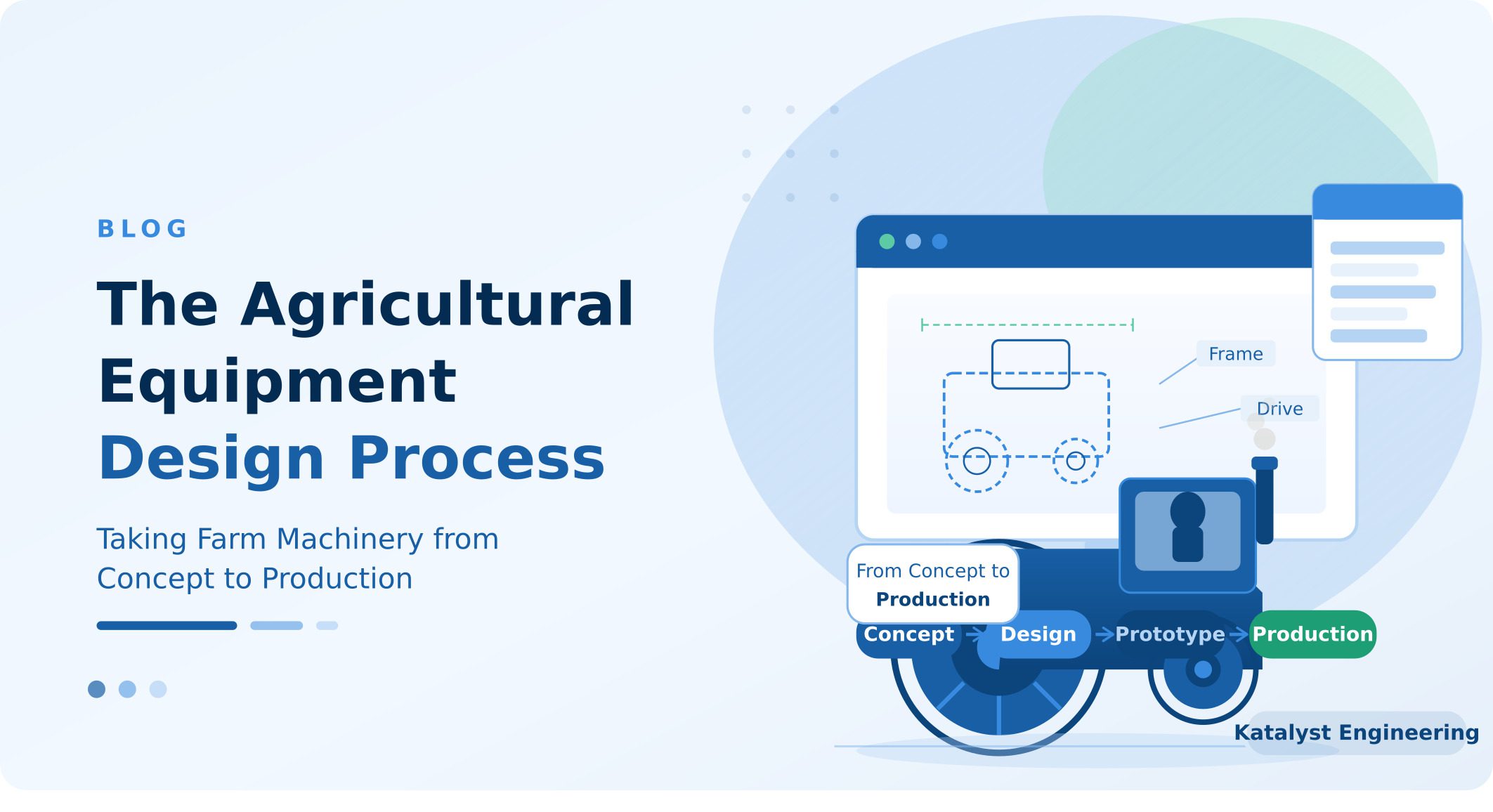
The agricultural equipment design process is a multi-phase engineering lifecycle that moves a machine from market requirements through conceptual layout, 3D CAD modeling, digital simulation (FEA/CFD), physical prototyping, and final manufacturing release.
During feasibility analysis, teams evaluate power requirements against weight limits to prevent soil compaction. Cross-functional teams also review early compliance targets, such as ROPS (Roll-Overprotective Structures) and FOPS (Falling-Object Protective Structures) standards.
Once the concept is approved, the project moves into rigorous 3D CAD modeling. This is where broad ideas become manufacturable parts.
Material selection is highly scrutinized here. High-strength, low-alloy (HSLA) steels are mapped for load-bearing chassis components, while engineered polymers are selected for cab interiors to reduce weight. OEMs frequently partner with external specialists for specialized subsystem design, utilizing mechanical engineering services to accelerate the detailed modeling phase without overburdening in-house staff.
Physical prototyping is too expensive and slow to rely on for iterative testing. Today, product design engineering relies heavily on digital twin environments to predict failures before metal is cut.
Finite Element Analysis (FEA) identifies stress concentrations in heavy linkages, while Computational Fluid Dynamics (CFD) optimizes cooling airflow around high-horsepower, Tier 4 Final engine bays.
Digital twin implementation (creating virtual replicas of physical assets) allows manufacturers to stress-test capital expenditure (CapEx) decisions through multi-scenario simulation, cutting physical prototyping costs by as much as 40%.
This direct reduction in lead time ensures OEMs can capitalize on seasonal buying cycles.
The shift to Tier 4 Final and Stage V emissions standards over the last decade forced a massive architectural overhaul across the agricultural machinery industry. OEMs like John Deere, CNH Industrial, and AGCO could not simply drop new engines into old chassis. The required Selective Catalytic Reduction (SCR) systems and Diesel Particulate Filters (DPFs) generated immense heat and required significantly more space. Engineering teams relied heavily on CFD to redesign engine bays, optimize thermal management, and reroute cooling packages, all while ensuring the larger engine hoods did not obstruct the operator’s line of sight to the field. This regulatory event proved that modern tractor design is as much about thermal management as it is about mechanical torque.
| Did You Know? In agricultural equipment design, standardizing communication between the tractor and the implementation is governed by ISO 11783, commonly known as ISOBUS. This standard ensures that a tractor from one OEM can seamlessly power and communicate with a planter or baler from a completely different manufacturer through a single plug-and-play terminal. (Source: International Organization for Standardization – ISO) |
No digital model survives first contact with a muddy field perfectly. Field validation involves instrumenting a physical prototype with strain gauges, accelerometers, and telematics.
These prototypes are subjected to accelerated lifecycle testing. Engineers push the machinery through worst-case scenarios: high-torque draft loads, extreme temperature fluctuations, and severe vibration tracks. Data gathered here is fed back into the CAD models to refine the design, ensuring OEMs are designing durable agriculture equipment that survives decades-long service lives.
A perfectly engineered planter is useless if it’s too complex or expensive to build at scale. DFM principles adapt the engineering model to standard manufacturing capabilities.
This phase minimizes custom tooling, standardizes fastener sizes across the BOM (Bill of Materials), and simplifies weld access for robotic arms.
| Traditional Design Approach | DFM-Optimized Approach | Business Impact |
| Custom brackets for every subsystem | Shared, standardized mounting hardware | Reduces BOM complexity and inventory holding costs |
| Complex, multi-pass blind welds | Accessible joints designed for automated robotic welding | Lowers cycle times, labor costs, and rework rates |
| Over-engineered plate thicknesses | Topologically optimized geometries | Reduces raw material costs and overall machine weight |
Before assembly lines start, the technical documentation must be finalized. Waiting until the machine is built to write the manuals creates massive shipping delays.
Service manuals, operator guides, and illustrated parts catalogs (IPCs) are generated concurrently directly from the final 3D CAD data. A streamlined process for creating technical publications ensures that dealer networks have the correct maintenance procedures the day the product launches.
Modern agricultural machinery manufacturing is integrating complex closed-loop hydraulics, 48V electrical architectures, and autonomous guidance systems into a single chassis. Which is a testament to the evolution of the technology in the sector, and with it comes the complexity of operations.
According to the USDA Economic Research Service, 70 percent of large-scale crop-producing farms now utilize guidance autosteering systems, up from single digits in the early 2000s. Furthermore, research from Purdue University’s Center for Commercial Agriculture indicates that tools like automated guidance and yield monitors are the primary technologies driving actual farm efficiency gains.
This massive adoption rate shifts the burden directly onto OEMs. Engineering teams must design scalable electrical architectures now to accommodate these highly sought-after precision sensors without compromising the physical ruggedness of the machine.
Successful agricultural equipment design hinges on shifting problem-solving to the earliest possible phases. When OEMs leverage comprehensive digital simulation and strict DFM principles, they prevent expensive manufacturing bottlenecks and late-stage redesigns. The transition from concept to production is no longer a linear relay race; it is a parallel, integrated effort between mechanical, electrical, and manufacturing teams. For manufacturers looking to accelerate their next product launch, scaling your design capability is the critical first step.
If you are a global OEMs with specialized engineering services, Contact Us and explore how Katalyst Engineering supports to bring durable, market-ready machinery to the field faster.

1.What are the biggest challenges in agricultural equipment design?
The primary challenge is balancing extreme mechanical durability with the integration of sensitive electronic components. Engineers must design chassis that withstand massive torsional loads and harsh environments while protecting precision sensors, IoT gateways, and complex hydraulic systems.
2. How does DFM reduce agricultural machinery manufacturing costs?
Design for Manufacturability (DFM) lowers costs by standardizing hardware, reducing the total part count, and optimizing geometries for automated fabrication. This leads to less scrap material, faster assembly cycle times, and a simplified supply chain.
3. What software is heavily used for farm machinery design?
OEMs rely on enterprise CAD platforms like Siemens NX, Dassault Systèmes CATIA, or PTC Creo for 3D modeling. For simulation, tools like ANSYS (for FEA) and specialized kinematics software are used to validate structural integrity and moving linkages prior to prototyping.
4. How do regulatory standards like ROPS and FOPS impact early-stage machinery design?
Roll-Over and Falling-Object Protective Structures (ROPS/FOPS) dictate the baseline structural requirements for the operator cab and main chassis. Engineers must integrate these heavy-duty load paths into the initial 3D CAD models before addressing secondary subsystems. Failing to account for these compliance standards early almost always leads to complete structural redesigns after a failed physical certification.
5. When should agricultural OEMs consider outsourcing mechanical engineering tasks?
OEMs typically outsource when internal engineering teams are bottlenecked by legacy product maintenance or when facing tight seasonal launch windows. Partnering with a specialized firm allows the OEM’s core engineers to focus on proprietary technology like autonomous guidance and IoT integration while the external partner accelerates heavy CAD modeling, FEA validation, and the creation of technical publications.
Bhavik Shah is the Vice President of Global Engineering and Manufacturing at Katalyst Engineering, with over 22 years of experience in the engineering industry. He specializes in product development, R&D, and engineering delivery operations, driving innovative, design-led solutions across automotive, industrial, and off-highway sectors. Bhavik plays a key role in strengthening engineering strategies, building global partnerships, and delivering high-performance outcomes for clients.
Need help understanding our services in depth? Our team of experts will specify everything you require. Tap on the Contact Us button and connect with our team today!