At Katalyst Engineering Services, we continually strive to drive innovation by deftly utilizing these resources, changing the issues encountered by various industries and fields with potential solutions.
At Katalyst Engineering Services, we continually strive to drive innovation by deftly utilizing these resources, changing the issues encountered by various industries and fields with potential solutions.

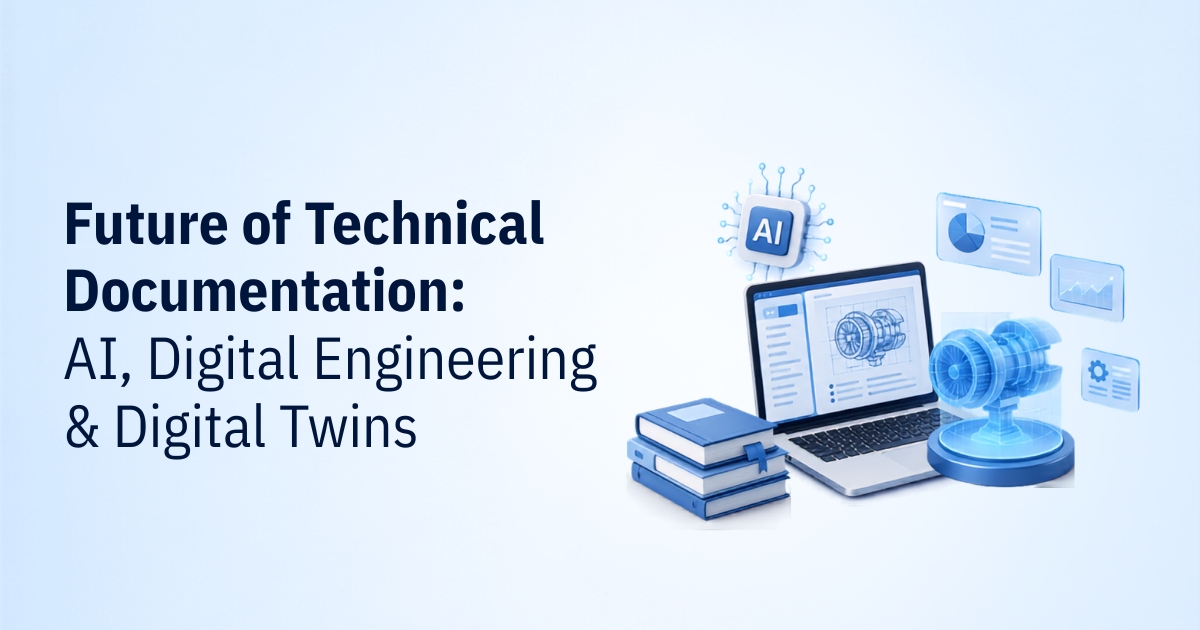
The future of technical documentation is moving beyond static manuals. AI in engineering, digital engineering, and digital twins in engineering are turning technical content into connected, context-aware information systems. Instead of documenting products after production, modern publications stay connected. They link live engineering data with asset configurations. They integrate diagnostics with step-by-step repair instructions. Everything reaches technicians directly at the point of need.
By eliminating legacy PDFs, engineering teams reduce mean time to repair (MTTR). Further, they improve compliance accuracy and maximize operational uptime across complex manufacturing ecosystems.

The future of technical documentation is connected, modular, AI-assisted, and context-aware. Rather than distributing monolithic, thousands-of-pages-long PDFs, organizations are transitioning to a unified ecosystem powered by structured XML data modules.
Static PDFs ──► Structured Data ──► Connected PLM ──► Context-Aware Content ──► Predictive Twins
Modern technical content pulls information straight from core product development systems, reflecting physical asset changes in real time.
The future of technical documentation connects PLM data. It uses real-time asset configurations and digital twins. AI-powered authoring creates accurate, localized instructions. Technicians receive instructions when and where needed.
Instead of searching through static manuals, field technicians receive customized procedural modules. These modules are linked directly to specific serial numbers, 3D CAD models, and active system diagnostics.
Integrating AI in engineering workflows transforms technical publishing from a manual drafting burden into an automated, highly accurate process.
Generative AI tools extract metadata from PLM and CAD systems to create initial drafts of service bulletins, operation guides, and fault isolation procedures. This allows subject matter experts (SMEs) to focus on safety validation rather than raw writing.
AI in engineering applications audit legacy documentation against Simplified Technical English (STE) standards. Natural Language Processing (NLP) identifies ambiguous phrasing, outdated part numbers, and terminology inconsistencies across massive global documentation libraries.
Rather than executing basic keyword searches across unstructured files, technicians interact with conversational AI agents trained on validated technical data. The system answers natural-language questions. They ask questions like “What is the torque value for this assembly?” They do so by pulling the precise specification for that exact asset configuration.
Deploying AI in engineering speeds up multi-language localization while keeping technical terminologies consistent across global service networks. Human reviewers step in solely to verify critical safety warnings.
Traditional publishing relies on disconnected documents created after engineering designs are finalized. In contrast, digital engineering integrates technical publications directly into the continuous digital thread. This helps in connecting design, manufacturing, and field service into a unified data ecosystem.
CAD Model ──► PLM System ──► Engineering Data ──► Technical Content ──► Service Delivery ──► Field Feedbac
When an Engineering Change Order (ECO) alters a component dimension inside CAD software, a digital engineering framework automatically flags affected maintenance modules for update. This smooth connection prevents version control failures and audit non-compliance on the shop floor.
| Digital Engineering Content Standard | Key Characteristics & Scope |
| S1000D |
|
| DITA (Darwin Information Typing Architecture) |
|
Adopting digital engineering principles ensures technical writers reuse validated data modules. This applies across all service manuals, parts of catalogs, and training programs without rewriting content from scratch.
Deploying digital twins in engineering shifts service operations from reactive maintenance to predictive asset management. A digital twin acts as a live, virtual counterpart of a physical asset, continuously updated by real-time IoT sensors.
When technical content connects with digital twins in engineering, manuals adapt dynamically to current physical conditions:
| Approach | Scope & Focus |
| Traditional Manual | “Here is how this machine model is generally serviced.” |
| Connected Content | “Here is how this specific machine design is configured.” |
| Digital Twin Manuals | “Here is what this exact physical asset needs right now.” |
Unstructured PDFs force technicians to leave the equipment to search for instructions. Modern Level 4 and Level 5 Interactive Electronic Technical Manuals (IETMs) bring critical data directly to the point of need via rugged tablets or Augmented Reality (AR) headsets.
| Capability | Legacy PDFs | Modern Point-of-Need Content |
| Data Format | Static, monolithic text | Reusable XML data modules |
| Searchability | Basic Ctrl+F text matching | Guided diagnostics & NLP query |
| Visual Depth | Flat 2D vector drawings | Rotatable 3D CAD & AR overlays |
| Update Cycle | Periodic manual re-issuing | Dynamic ECO-driven synchronization |
Delivering contextual, visual-first documentation directly to field engineers slashes mean time to repair (MTTR) while preventing human error during complex maintenance operations.
By 2030, the future of technical documentation will center on autonomous, fully integrated content environments:
The role of the technical communicator is shifting from primary writer to system architect and safety editor. Technical writers now focus on managing automated pipeline rules, establishing style constraints, and performing critical safety validations.
Meanwhile, AI in engineering tools handle the initial generation, structural alignment, and preliminary formatting of complex documentation sets. This dramatically accelerates the authoring lifecycle.
Static publishing cycles and periodic document revisions are being replaced by real-time automated workflows. Technical publications sync instantly with digital engineering platforms. It helps in ensuring that every engineering change order (ECO) or CAD design tweaks update downstream documentation immediately.
This continuous deployment model eliminates manual publishing releases, drastically reducing administrative delays. Additionally, it guarantees that field technicians always access the most up-to-date procedures.
Static manuals give way to dynamic, event-driven service instructions. Documentation actively reacts to live asset telemetry sourced from digital twins in engineering. This automatically generates serial number-specific work orders on the fly.
When real-time IoT sensors detect performance anomalies or wear, the system immediately delivers targeted, predictive maintenance guidance to technicians before equipment failure can occur.
Information delivery is shifting from two-dimensional displays to immersive, hands-free field applications. Technicians interact directly with AR-guided visual flows layered precisely over physical machinery using spatial computing headsets and smart glasses.
Complex maintenance tasks become safer, faster, and far less prone to human error. This is mainly done by projecting interactive 3D overlays, structural CAD views, and real-time step-by-step repair sequences onto the physical asset.
Transitioning from static manuals to an integrated technical publishing pipeline requires a step-by-step strategy:
The future of technical documentation is no longer about managing static files. It is about building a connected, intelligent information ecosystem. As maintenance demands increase and asset complexity grows, legacy PDFs and disconnected manuals create costly operational friction. By combining AI in engineering, digital engineering workflows, and digital twins in engineering, organizations can turn technical publications into a dynamic operational asset. This asset drives uptime, lowers MTTR, and guarantees strict regulatory compliance.
Katalyst Engineering stands apart as a strategic partner in this digital transformation. We are not like traditional publishing agencies that merely convert legacy files. Katalyst Engineering bridges the gap between complex hardware design and modern software ecosystems. We deeply integrate technical publications directly into your PLM, CAD, and IoT frameworks. We enable a unified platform for publishing, predictive maintenance delivery, and effortless compliance automation. We ensure your technical data scales as fast as your physical capabilities.

1. What is the future of technical documentation?
The future of technical documentation is connected, modular, and context aware. It integrates AI in engineering, digital engineering pipelines, and digital twins in engineering. It delivers real-time, asset-specific instructions directly to technicians at the point of need.
2. How is AI in engineering changing technical documentation?
AI in engineering automates initial content drafting from PLM metadata, audits technical terminology against Simplified Technical English (STE) standards. It accelerates global translation and enables conversational natural-language querying across large technical publication libraries.
3. What role does digital engineering play in technical documentation?
Digital engineering connects technical publishing directly to the product lifecycle management (PLM) ecosystem. This establishes a continuous digital thread where engineering change orders (ECOs) automatically trigger updates in downstream technical documentation.
4. How are digital twins in engineering used for maintenance documentation?
Digital twins in engineering feed real-time IoT sensor data into technical publications. This allows documentation systems to dynamically generate predictive maintenance checklists. It also helps in generating configuration-specific repair steps customized to an exact asset’s serial number and operational condition.
5. Will AI replace technical writers and engineers?
No. While AI automates routine drafting, data conversion, and formatting tasks, human technical writers and subject matter experts (SMEs) remain critical for verifying procedural safety, maintaining regulatory compliance, and managing overall content strategy.

Senior Vice President, Katalyst Engineering
Bhavik Shah is the Vice President of Global Engineering and Manufacturing at Katalyst Engineering, with over 22 years of experience in the engineering industry. He specializes in product development, R&D, and engineering delivery operations, driving innovative, design-led solutions across automotive, industrial, and off-highway sectors. Bhavik plays a key role in strengthening engineering strategies, building global partnerships, and delivering high-performance outcomes for clients.