At Katalyst Engineering Services, we continually strive to drive innovation by deftly utilizing these resources, changing the issues encountered by various industries and fields with potential solutions.
At Katalyst Engineering Services, we continually strive to drive innovation by deftly utilizing these resources, changing the issues encountered by various industries and fields with potential solutions.
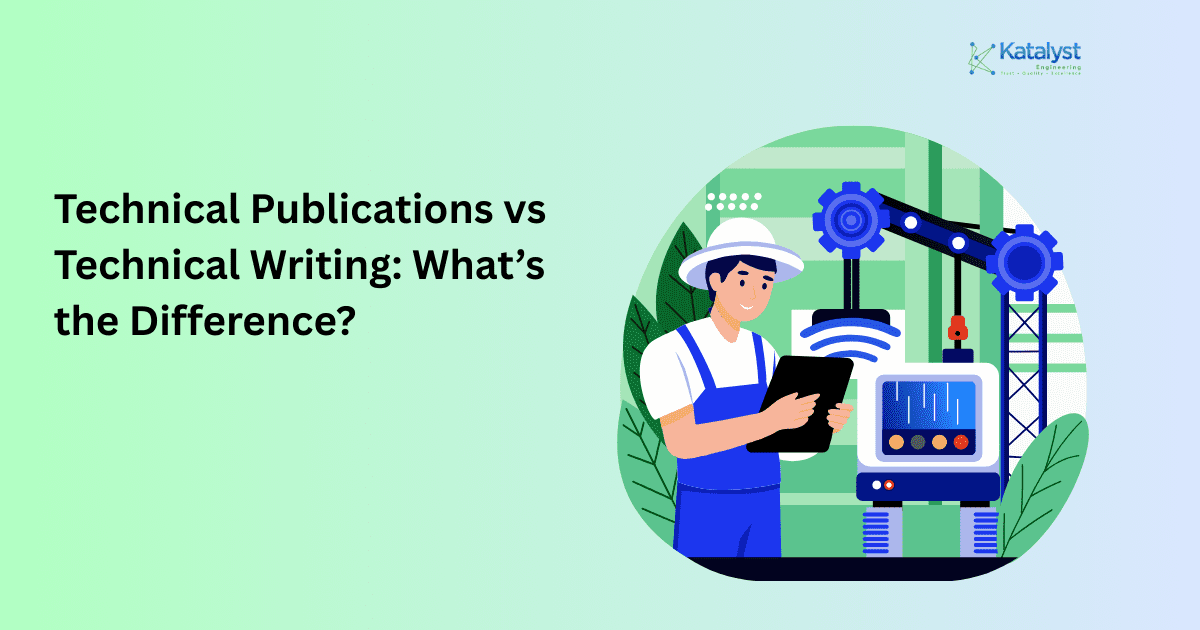
In complex engineering and manufacturing environments, clarity is not optional. It is operationally critical. Yet many organizations still confuse technical writing with technical publications. While the two functions are closely related, they are not identical. Understanding this distinction helps leaders structure documentation processes more effectively. It also improves compliance, product usability, and customer experience.
For companies managing global operations, especially in aerospace, automotive, and industrial manufacturing, documentation must meet strict regulatory and quality standards. That is where technical writing plays a foundational role. But technical publications service extend beyond writing alone. Let us break down the difference in a structured and practical way.
Technical writing is the process of translating complex engineering, scientific, or industrial information into clear, structured, and usable content. It focuses on accuracy, clarity, and usability. It supports engineers, technicians, operators, and end users.
It answers a fundamental question: what is technical documentation and how should it be structured for real-world use? Technical writing covers manuals, SOPs, installation guides, maintenance procedures, API documentation, and regulatory files. These are commonly referred to as technical writing documents. The goal is simple. Reduce ambiguity. Improve comprehension. Enable safe and efficient operations.
Professional technical writing ensures that documentation is consistent, compliant, and aligned with industry standards. In regulated sectors, poorly written documentation can lead to operational risks and compliance failures. That is why writing quality directly affects business outcomes.

The technical publications can be described as the larger system comprising of content creation, formatting, design, version control, illustration, localization and digital publishing. It comprises a full documentation life cycle. Teams of technical publications deal with structured authoring systems, XML processes, and content management systems.
Publications teams support technical publications in manufacturing with illustrated parts lists, service bulletins, maintenance manuals and compliance documents. A technical writer employed by the manufacturing company might play the role of contributing to the writing, however publication is done by the publications team to ensure uniformity in formatting and regulations in different regions.
Concisely, a fundamental role in technical publications is the technical writing. Writing creates the content. It is operationalized and managed at scale by publications.
Did you know?Structured technical writing documents (using XML or DITA frameworks) can reduce publishing time by up to 25%? |
Below is a structured comparison to clarify the distinction:
| Criteria | Technical Writing | Technical Publications |
| Primary Focus | Content creation | Content lifecycle management |
| Key Role | Develop accurate documentation | Manage formatting, publishing, and distribution |
| Tools Used | Authoring tools, style guides | CMS, XML systems, publishing software |
| Output | Manuals, SOPs, guides | Published manuals, digital libraries, catalogs |
| Stakeholders | Engineers, SMEs, compliance teams | Engineering, operations, IT, quality |
Technical writing services often integrate into publications frameworks. However, not every publication team performs deep subject-level writing. Understanding this separation helps organizations allocate resources correctly.
What most executives continue to wonder is what technical documentation entails other than manuals. Nowadays, there are the digital workflow, organized data storage, inbuilt helpdesk and knowledgebase.
The technical writing documents of the modern era are growing more modular and are organized with the help of such standards as DITA or S1000D. The strategy enables re-use of content and dynamism. It also minimizes product line duplication.
Companies that spend on professional technical writing experience tangible benefits of efficiency. Research shows that firms that have well-organized documentation systems minimize assistance calls by approximately 30%. That is a saving on the costs and enhanced customer satisfaction.
Documentation is no more a static one. It is integrated, data-driven and dynamic.
Engineering teams are under pressure to innovate faster. However, documentation often becomes a secondary priority. This leads to outdated manuals, inconsistent instructions, and knowledge silos.
Technical writing for engineers bridges this gap. Writers collaborate with design teams early in the product lifecycle. This ensures documentation evolves alongside engineering development.
Recent industry surveys show that organizations integrating documentation in early product development cycles reduce rework by nearly 15%. Clear documentation also accelerates onboarding for new engineers.
When writing is integrated into engineering workflows, knowledge becomes an asset rather than an afterthought.
The landscape of documentation is changing rapidly. Three major trends are influencing both technical writing and publications:
The future is not just about writing. It is about intelligent content management.
This list helps engineering leaders quickly diagnose documentation maturity.
1) Documentation is created only after product release.
2) Engineers write manuals without structured editorial review.
3) There is no standardized template across departments.
4) Technical content is duplicated across product lines.
5) Regulatory audits highlight documentation inconsistencies.
6) Customers frequently raise usability or clarity concerns.
7) Updates take weeks due to unstructured publishing systems.
Documentation, in heavily regulated industries, requires engineering precision. Organizations with domain expertise, coupled with structured technical writing frameworks, achieve superior results.
Engineering-focused firms like Katalyst Engineering show how documentation integrates with design, manufacturing, and lifecycle support. Their approach reflects an understanding that technical writing doesn’t exist in a vacuum from operations; it’s part of the engineering ecosystem.
An integrated model ensures documentation accuracy, regulatory compliance, and lifecycle traceability. It strengthens collaboration between engineers and documentation specialists. Knowledge in the domain, as well as maturity in the processes, contributes toward authority in documentation.
If you are assessing your documentation framework, start with an internal audit. Evaluate your technical writing documents for clarity, consistency, and compliance alignment. Review how your publications workflows manage updates and distribution.
For organizations seeking structured, engineering-aligned documentation strategies, partnering with experienced technical writing services providers can create measurable impact. The right approach transforms documentation from a cost center into a strategic asset.
Documentation is not just about writing. It is about enabling performance across the product lifecycle.

A: Technical writing focuses on creating clear and accurate documentation, while technical publications manage formatting, structuring, publishing, and lifecycle control of that content.
A: Technical documentation includes manuals, SOPs, service guides, and compliance documents that help engineers and technicians operate, maintain, and support products effectively.
A: Organizations should invest in professional technical writing when documentation gaps affect compliance, product usability, or operational efficiency.
A: Technical writing for engineers ensures complex technical information is structured clearly, reducing errors, rework, and support queries.
A: Katalyst Engineering integrates engineering expertise with structured documentation processes to deliver accurate, compliant, and scalable technical publications.
Bhavik Shah is the Vice President of Global Engineering and Manufacturing at Katalyst Engineering, with over 22 years of experience in the engineering industry. He specializes in product development, R&D, and engineering delivery operations, driving innovative, design-led solutions across automotive, industrial, and off-highway sectors. Bhavik plays a key role in strengthening engineering strategies, building global partnerships, and delivering high-performance outcomes for clients.
Need help understanding our services in depth? Our team of experts will specify everything you require. Tap on the Contact Us button and connect with our team today!