At Katalyst Engineering Services, we continually strive to drive innovation by deftly utilizing these resources, changing the issues encountered by various industries and fields with potential solutions.
At Katalyst Engineering Services, we continually strive to drive innovation by deftly utilizing these resources, changing the issues encountered by various industries and fields with potential solutions.
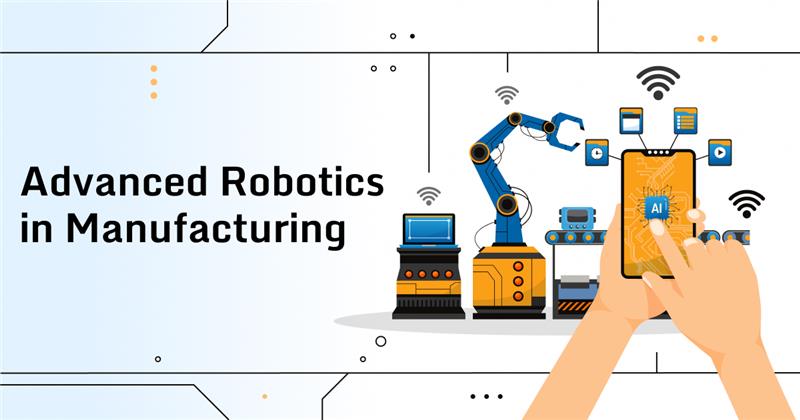
Manufacturing is moving into the age of efficiency, flexibility, and precision as a characteristic of competitiveness. The development of robotics in manufacturing has transformed from single automation cells to intelligent and interconnected systems to facilitate end-to-end production processes. Speed is not the only priority of the modern factories but also consistency, traceability and resilience through manufacturing services.
A high level of robots helps manufacturers to react to a change in demand, quality needs and labour limitations. Recent industry research by 2024-2025 shows that manufacturers implementing advanced robotics have over 20% productivity improvement and defect reduction of nearly 30%.
These results illustrate how robotics has become a strategic investment and not a tactical upgrade, transforming business operations in the automotive industry, electronics, heavy engineering, and consumer goods industry.
Wondering how to align innovation with efficiency in your operations? Our tailored solutions bridge the gap seamlessly
In manufacturing, advanced robotics combine sensors, AI-controlled movements, and real-time data analysis to leave behind repetitive movement. These systems are unlike conventional maintenance, optimization of the process, and adaptive quality control.
Manufacturers that have implemented advanced automation are adjustable to variable inputs and dynamic production conditions. The intelligence is used in predictive robotics claim that their uptimes and use of assets have improved measurably. The use of advanced robotics enables production lines to rearrange at an accelerated rate, and therefore, they can support mass customization without affecting the throughput or quality.
Successful robotics integration depends on aligning technology with existing workflows, not replacing them abruptly. Integration strategies focus on modular deployment, interoperability with legacy systems, and scalable architecture.
Manufacturers increasingly prefer phased integration to reduce risk and ensure operational continuity. Key integration considerations include system compatibility, workforce readiness, and data synchronization across machines.
These approaches help organizations achieve smoother transitions while maximizing ROI from robotics investments.
Industrial robotics forms the core of modern automated factories by delivering reliable, repeatable performance in environments where consistency is critical. These systems support large-scale production without fatigue or variation.
Industrial robots are designed to perform tasks with extremely tight tolerances, making them ideal for applications where even minor deviations can impact product quality. This precision helps reduce errors and maintain uniform output.
Robotic systems are engineered for uninterrupted operation across multiple shifts, enabling manufacturers to maintain high throughput. Their ability to operate at consistent speeds ensures predictable production cycles.
Applications such as material handling, palletising, and high-speed assembly benefit from the strength and repeatability of industrial robots. Their adaptability allows deployment across multiple stages of the production line.
When integrated with advanced sensing and control technologies, industrial robots perform reliably even in harsh conditions. This makes them suitable for environments involving heat, dust, vibration, or heavy loads.
Industrial robotics enables manufacturers to scale production efficiently without compromising quality. Their robustness and long operational life make them indispensable for sustained, high-volume manufacturing.
The collaborative robots are restructuring the processes in the shop-floor safety with human workers. Cobots are flexible, easy to deploy and easy to program (unlike traditional robots). This renders them suitable for small and medium-sized manufacturers that require a slow automation process.
Collaborative robots with automation help in activities such as inspection, packaging, and light assembly with only a few modifications in the infrastructure. Collaborative robots are more productive and do not reduce the agility of the workforce by combining human judgment and robot accuracy.
In increasingly advanced manufacturing, specialized robotic applications are becoming necessary regarding specialized processes. In the assembly of electronics and vehicles, robot assembly systems provide high accuracy, quickness and integration of parts. These systems minimize cycle time, and the quality is consistent. On the same note, robotic welding systems provide high quality welds, better safety, and less material wastages.
Producers who have implemented robotic welding have recorded up to 40% in the consistency of the welds and a high rate of injuries in the workplace being reduced. These advanced robotic systems can help keep up with high standards of quality and enhance the performance of the whole operation.
Advanced robotics for manufacturing delivers measurable business outcomes supported by recent industry data. Between 2024 and 2025, manufacturers leveraging robotics-driven automation achieved faster time-to-market and improved energy efficiency.
Key performance impacts include:
| Performance Area | Impact Range | Operational Benefit |
| Productivity | 20–25% improvement | Faster throughput and more efficient automated production lines |
| Product Quality | Up to 30% defect reduction | Improved consistency through real-time quality monitoring |
| Energy Efficiency | 15–20% energy savings | Lower operational costs using optimized robotic motion and scheduling |
Katalyst Engineering brings deep domain expertise in designing and implementing advanced manufacturing solutions tailored to complex industrial environments. With a strong focus on robotics integration and system-level engineering, the company supports manufacturers across automation planning, deployment, and optimization.
Katalyst Engineering emphasizes scalable architectures, operational safety, and long-term performance. Its engineering-led approach ensures that robotics in manufacturing aligns with production goals, compliance requirements, and digital transformation strategies. By combining technical rigor with industry insight, Katalyst Engineering helps organizations adopt robotics as a sustainable operational advantage rather than a short-term upgrade.
Manufacturers evaluating advanced robotics in manufacturing should begin with a clear assessment of process maturity and automation readiness. A phased roadmap enables risk-managed adoption while delivering measurable value at each stage.
Engaging experienced engineering partners ensures robotics solutions are aligned with operational realities and future scalability. Organizations that invest thoughtfully today will build resilient, data-driven production systems capable of adapting to tomorrow’s manufacturing challenges.
Struggling with designs that don’t scale or processes that slow you down? Katalyst helps you engineer smarter, faster, and better.
Bhavik Shah is the Vice President of Global Engineering and Manufacturing at Katalyst Engineering, with over 22 years of experience in the engineering industry. He specializes in product development, R&D, and engineering delivery operations, driving innovative, design-led solutions across automotive, industrial, and off-highway sectors. Bhavik plays a key role in strengthening engineering strategies, building global partnerships, and delivering high-performance outcomes for clients.
Need help understanding our services in depth? Our team of experts will specify everything you require. Tap on the Contact Us button and connect with our team today!