At Katalyst Engineering Services, we continually strive to drive innovation by deftly utilizing these resources, changing the issues encountered by various industries and fields with potential solutions.
At Katalyst Engineering Services, we continually strive to drive innovation by deftly utilizing these resources, changing the issues encountered by various industries and fields with potential solutions.

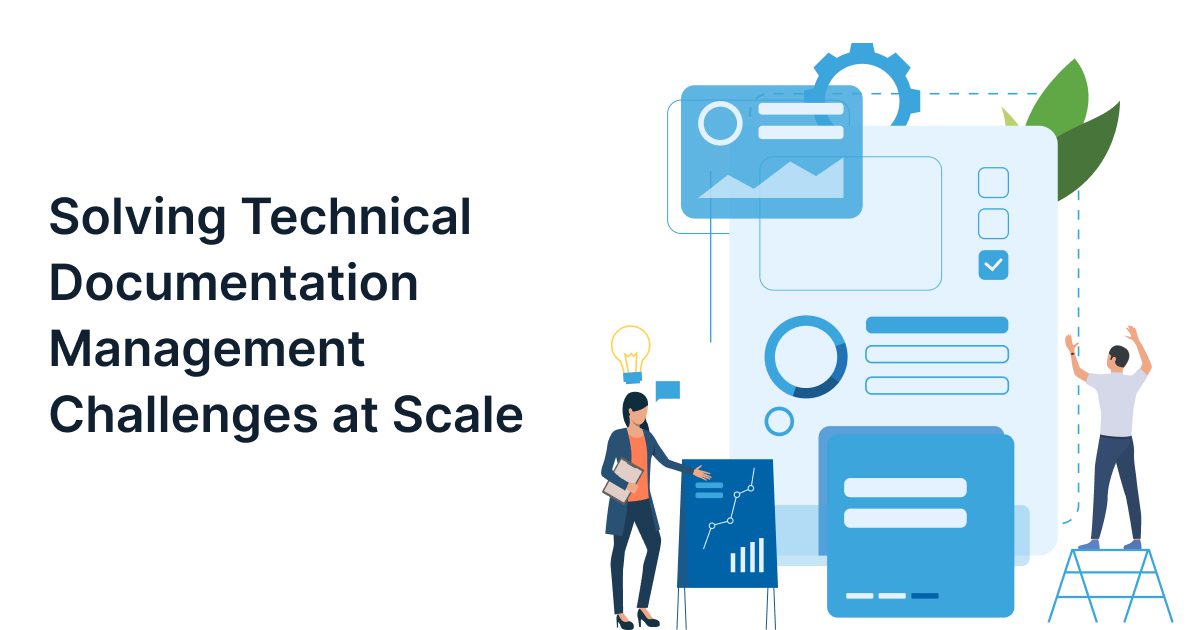
A minor revision to a torque specification in your CAD software takes an engineer five minutes. Pushing that exact change across maintenance manuals, illustrated parts catalogs (IPCs), and operator training guides in twelve different languages can take a technical publications team three weeks.
This disconnect between product lifecycle management (PLM) and technical publications is the root cause of the most expensive challenges in technical writing. When documentation workflows rely on manual updates and disconnected text files, the risk of an outdated procedure reaching the shop floor skyrockets. Engineers reading this know the business consequence: if the manual doesn’t match the machine, production halts, audits fail, and liability increases.
At a certain scale, adding more technical writers does not solve output problems; it simply scales the inefficiency. The most pressing challenges faced by technical writers in industrial environments stem from architectural flaws in how data is stored and shared.
When technical data is locked inside static PDFs or unstructured Word documents, content reuse is impossible. A standard safety warning might appear 400 times across an OEM’s product literature. If regulatory standards change, writers must manually find and update all 400 instances. Human error in this process directly leads to compliance gaps. Understanding how poor technical documentation impacts product safety compliance is critical for operations leads trying to justify investments in better infrastructure.
Furthermore, writers are constantly forced to chase subject matter experts (SMEs). Without a digital thread connecting the engineering bill of materials (eBOM) to the manual, writers spend more time verifying data accuracy than drafting content.

Why it matters: Poor documentation workflow management drains highly paid engineering talent away from product development.
Why it matters: Inadequate technical documentation management directly triggers regulatory enforcement, delaying product releases and damaging market trust.
To solve these bottlenecks, organizations often mistakenly invest in a standard Document Management System (DMS). A DMS is essentially a digital filing cabinet, it tracks versions of entire files. It does not solve the root problem of unstructured data.
Heavy engineering requires a Component Content Management System (CCMS). A CCMS breaks documents into XML-based modular components. Instead of managing a 1,000-page manual, the system manages thousands of individual topics, warnings, and procedures. If a procedure changes, you update the XML component once, and every manual referencing that component updates automatically.
| Capability | Standard Document Management System (DMS) | Component Content Management System (CCMS) | Business Consequence |
| Data Structure | File-based (PDF, DOCX) | Modular, Component-based (XML, DITA) | CCMS allows for single-source-of-truth updates. |
| Content Reuse | Copy/Paste | Dynamic referencing | CCMS drastically reduces drafting and translation costs. |
| Formatting | Manual layout by the author | Automated publishing engines | Writers focus on technical accuracy, not layout. |
| PLM Integration | Limited to file attachments | API-driven component updates | Prevents outdated specs from reaching end-users. |
Effective documentation workflow management requires removing technical writers from the formatting business. When writers use structured authoring tools, they write raw XML data. The system’s publishing engine then applies the correct formatting rules depending on whether the output is a printable PDF or an Interactive Electronic Technical Manual (IETM) viewed on a tablet.
This separation of content and format is crucial for maintaining compliance across global markets. For OEMs navigating complex regulatory landscapes, this structured approach is non-negotiable. It reinforces the role of technical publications in compliance standards, ensuring that every deployed manual meets the exact requirements of ISO, FDA, or FAA auditors.
Consider the regulatory environment of medical device manufacturing under ISO 13485 and FDA 21 CFR Part 820. If an OEM discovers that a specific sterilization cycle causes premature wear on a surgical tool, engineering issues an immediate update to the Instructions for Use (IFU).
In an unstructured environment, the quality team must manually recall and replace localized PDFs across European, Asian, and North American distribution hubs. If a single outdated IFU remains active and leads to patient harm due to the old sterilization procedure, the OEM faces catastrophic liability. In a CCMS environment, the updated sterilization XML component is instantly pushed to the localization vendor, and updated digital IFUs are simultaneously published to the global portal, ensuring airtight version control.
Even with a robust CCMS, migrating legacy PDFs into structured XML data is a massive operational hurdle. It requires parsing thousands of pages, stripping formatting, and tagging data accurately. Attempting this data conversion with an internal team usually halts regular updates, leading to a backlog of outdated manuals.
To maintain uptime and output during a system migration, manufacturers frequently rely on technical publication services. Engaging an outsourced team of technical authors and illustrators allows the OEM to push through the heavy lifting of legacy data conversion while keeping current product documentation strictly aligned with ongoing engineering changes.
Technical documentation management is a critical engineering function that directly dictates product uptime, compliance risk, and post-sale profitability. Continuing to manage complex machinery manuals using unstructured word processors guarantees higher costs and slower update cycles.
By migrating to structured, component-based authoring and integrating documentation workflows tightly with PLM systems, OEMs can finally treat their manuals with the same precision as their physical products.
If your internal team is bogged down by manual formatting or staring down a massive backlog of legacy PDFs that need to be converted into structured XML, you don’t have to pull engineers off core product development to get it done, contact us to map out a structured data conversion strategy with our team of experts .

1. What is the biggest challenge in technical documentation management?
The primary challenge is maintaining version control across multiple manuals and languages when engineering changes occur. Without a structured single-source-of-truth, updating documentation is a highly manual, error-prone process that delays product releases.
2. How does a CCMS solve technical writing challenges?
A Component Content Management System (CCMS) stores data as modular, reusable components rather than full documents. This means a technical writer only has to update a specific procedure or warning once, and the system automatically updates every manual that references it.
3. Why is documentation workflow management critical for compliance?
Regulatory bodies like the FDA and FAA require strict traceability and document control. Effective workflow management ensures that obsolete procedures are immediately removed from circulation and that all published manuals accurately reflect the latest approved engineering specifications.
4. How do you measure the ROI of technical documentation management software?
The most immediate return on investment is seen in drastically reduced localization costs and accelerated time-to-market. By migrating to a structured system, organizations only pay to translate newly updated components rather than entire manuals, while simultaneously eliminating hundreds of labor hours previously spent on manual PDF formatting.
5. What is the difference between unstructured and structured document management? Unstructured management relies on tracking static files like PDFs or Word documents, requiring writers to manually find and update information across every existing manual. Structured management treats text as modular data (XML), allowing a single procedural update to automatically sync across dozens of different product configurations and output formats.

Senior Vice President, Katalyst Engineering
Bhavik Shah is the Vice President of Global Engineering and Manufacturing at Katalyst Engineering, with over 22 years of experience in the engineering industry. He specializes in product development, R&D, and engineering delivery operations, driving innovative, design-led solutions across automotive, industrial, and off-highway sectors. Bhavik plays a key role in strengthening engineering strategies, building global partnerships, and delivering high-performance outcomes for clients.