At Katalyst Engineering Services, we continually strive to drive innovation by deftly utilizing these resources, changing the issues encountered by various industries and fields with potential solutions.
At Katalyst Engineering Services, we continually strive to drive innovation by deftly utilizing these resources, changing the issues encountered by various industries and fields with potential solutions.

Preparing for 2026: Why Sustainable Engineering Is Now a Business Imperative
As organizations gear up for 2026, sustainable engineering has transitioned from a hopeful aspiration to an essential operational necessity. Stricter environmental policies, shifting ESG standards, and increasing lifecycle expenses are compelling companies to rethink their approaches to engineering decisions in terms of governance and evaluation.
In 2026, sustainable engineering will be characterized by accountability, risk management, and resilience in systems. Firms that incorporate sustainability into their engineering governance are in a stronger position to ensure compliance, manage operational risks, and adjust to market uncertainties.
Instead of viewing sustainability as an additional element, forward-thinking organizations will weave it into the fabric of design, material selection, manufacturing practices, and technology utilization. This cohesive strategy minimizes rework, curtails resource wastage, and enhances long-term performance across systems.

Green technologies are pivotal to implementing sustainable engineering on a large scale. By 2026, engineering teams will increasingly depend on intelligent, data-informed systems to enhance efficiency and foresee risks throughout complex operations. These tools enable continuous monitoring of energy usage, predictive maintenance, and system-wide optimization. The most significant benefits arise when these tools are integrated into operational workflows rather than being limited to stand-alone dashboards.
Some of the green technology applications in engineering that are quite common are:
| Green technology | What it does | Primary sustainability value |
| Digital twins | Simulates real assets/processes virtually to test scenarios before changes are made | Reduces rework and waste by validating designs and operational improvements early |
| AI energy & asset optimization | Analyzes operational data to recommend energy, setpoint, and maintenance optimizations | Cuts energy use and improves reliability while extending equipment life |
| Smart monitoring systems | Tracks performance in real time and flags anomalies or inefficiencies | Enables continuous efficiency improvement and faster corrective action |
Digital twins allow virtual testing of physical systems, so inefficiencies can be identified prior to actual implementation.
AI-driven energy and asset optimization scrutinize operational data to curtail energy consumption, improve forecasting accuracy, and extend the longevity of assets.
Smart monitoring systems offer real-time insights into operations, enabling more swift decision-making and continuous advancement.
Material selection is vital for lessening environmental impact. By 2026, engineering teams will focus on durability, recyclability, and embodied carbon, alongside traditional cost factors.
Lifecycle-focused material strategies will mitigate supply chain risks, aid regulatory compliance, and enhance long-term reliability.
The criteria for evaluating materials will include lifecycle environmental impact, performance under stress, and potential for recovery at end-of-life.
| Evaluation criterion | Why it matters | How to assess |
| Lifecycle environmental impact | Captures total footprint beyond procurement cost | Run LCA or supplier EPD review; compare embodied carbon per unit |
| Performance under operational stress | Avoids failures, rework, and premature replacements | Test for temperature, corrosion, fatigue; validate against real duty cycles |
| End-of-life recovery / reuse | Supports circularity and reduces disposal risk | Check recyclability, disassembly time, take-back options, recovery yield |
Sustainable design focuses on creating modular and adaptable systems, minimizing waste, and facilitating future upgrades. Early incorporation of sustainable design principles decreases rework and secures long-term efficiency.
Eco-friendly manufacturing applies sustainable engineering concepts to production settings. Optimizing processes, minimizing waste, and utilizing resources efficiently lead to measurable enhancements in performance.
Key areas of focus include reducing and reusing waste, adopting energy-efficient production techniques, and implementing closed-loop material and water cycling.
Low-carbon engineering demands precise measurement and well-informed decision-making. Carbon analytics and lifecycle assessment tools allow organizations to prioritize emission reductions while ensuring system efficacy.
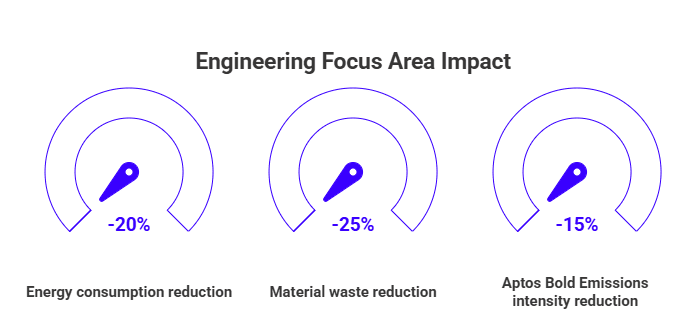
At Katalyst Engineering, sustainable engineering is viewed as a disciplined and quantifiable approach. The firm integrates sustainability principles within design, materials, production, and technology, emphasizing the practical application and measurability of the process.
Preparing for 2026 requires a systemic approach. Even incremental measures can effectively reduce risks and costs. Sustainable engineering is a continuous journey were advanced planning leads to enhanced outcomes. Begin with Katalyst Engineering to understand the comparison of the existing systems against sustainable engineering standards and performance data. Incremental improvements today reduce future risk and cost. Sustainable engineering is a continuous process that rewards organizations prepared to act early and decisively.

1. What is sustainable engineering in 2026?
A: Sustainable engineering aims to harmonize performance, cost-effectiveness, and environmental stewardship throughout the entire lifecycle.
2. Why is sustainable engineering important for enterprises?
A: It mitigates regulatory risks, decreases lifecycle expenses, and enhances system durability.
3. How do green technologies support sustainable engineering?
A: They facilitate real-time monitoring, predictive enhancements, and decisions based on data.
4. What role do eco-friendly materials play?
A: They lower embodied carbon and enhance recyclability while maintaining performance standards.
5. What is sustainable design in engineering?
A: It incorporates efficiency, flexibility, and minimal resource consumption during the planning phase.

Senior Vice President, Katalyst Engineering
Bhavik Shah is the Vice President of Global Engineering and Manufacturing at Katalyst Engineering, with over 22 years of experience in the engineering industry. He specializes in product development, R&D, and engineering delivery operations, driving innovative, design-led solutions across automotive, industrial, and off-highway sectors. Bhavik plays a key role in strengthening engineering strategies, building global partnerships, and delivering high-performance outcomes for clients.