At Katalyst Engineering Services, we continually strive to drive innovation by deftly utilizing these resources, changing the issues encountered by various industries and fields with potential solutions.
At Katalyst Engineering Services, we continually strive to drive innovation by deftly utilizing these resources, changing the issues encountered by various industries and fields with potential solutions.

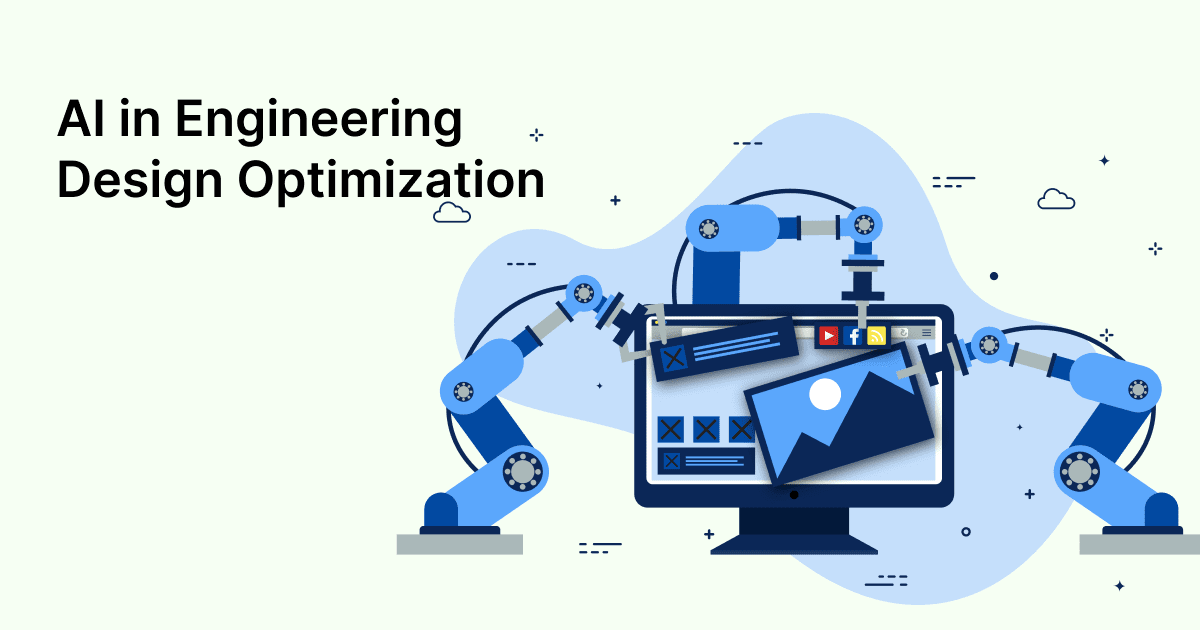
Engineering teams are expected to deliver lighter, stronger, safer, and more cost-effective products, faster than ever. Yet many organizations still rely on a familiar loop: create a concept, run analysis, revise geometry, validate, and repeat. The approach works, but it limits how many alternatives teams can explore before time and cost pressures to force decisions – often resulting in designs that are “good enough” rather than truly optimized.
For teams looking to operationalize these approaches, aligning technical goals with the right Engineering Services specially Manufacturing Engineering, helps connect design decisions to production readiness
AI in engineering design refers to applying AI techniques, especially machine learning to accelerate decisions across concept evaluation, simulation workflows, and design iteration. Instead of replacing engineers, AI acts as a force multiplier: it expands the design space, reduces repetitive work, and helps teams converge faster on high-performing solutions.
In practical terms, AI can help teams:

Design teams don’t suffer from a lack of ideas; they suffer the cost of validating them. Running many cycles of simulation and refinement is time-consuming, and teams often can’t explore alternatives that deviate from initial assumptions.
The most relevant gains show up when AI is integrated into day-to-day engineering workflows supporting faster exploration, better early trade-offs, and stronger decisions before downstream commitments.
As AI becomes normal across enterprises, engineering organizations need a practical approach to validation and governance, especially where safety, compliance, and reliability matter.
For additional real-world examples of AI applied across engineering workflows, GenAI in Engineering: Use Cases and Opportunities highlights where teams are getting early wins and what to prioritize first.
AI delivers the best results in workflows that are repeatable, constraint-heavy, and supported by data simulation histories, test results, and field feedback.
The first stage of any project holds the greatest potential for impact, but most teams restrict their concept evaluation to a few options because of time constraints and computational resource availability. The AI-based engineering design optimization system produces and ranks design candidates based on mass and stiffness and stress and thermal and packaging and cost performance metrics to help teams select optimal solutions before making major project decisions. Faster engineering design analysis using surrogate models
High-fidelity FEA/CFD remains essential, but it can become a bottleneck when teams must run many iterations. A practical method is machine learning surrogate modeling, where an ML model is trained on a curated set of high-fidelity results to provide fast “what-if” predictions. Engineers then validate the top candidates with full simulation before sign-off.
A significant portion of engineering effort is repetitive: generating variants, updating drawings, applying standards, checking clearances, and maintaining BOM consistency. Design automation reduces this load through templates, parametric logic, and rule checks. At scale, automated design systems combine reusable models, engineering rules, and workflow automation, so teams can deliver consistent variants across product families with less manual effort.
| Approach | What it does (simple) | Engineering value | Where it fits best |
| Machine learning (predictive models) | Learns from past simulation/test data to predict performance trends | Faster decisions with fewer iterations | Early mid design |
| Surrogate models (simulation speed-up) | Approximates FEA/CFD results for rapid “what-if” studies | Shorter analysis cycle time | Concept → optimization loops |
| AI-assisted optimization | Searches design parameters to meet constraints (weight, strength, cost) | Better trade-offs and stronger solutions | Concept selection |
| Constraint-driven generative design | Generates geometry options within defined rules/limits | Expands the design space quickly | Early concept |
| Design automation | Automates repeatable CAD updates and variant creation | Faster variant engineering, fewer manual errors | Mid–late design |
| Automated design systems | Scales rules + templates + workflows across product families | Consistency, reuse, predictable delivery | Platform / family engineering |
To connect design decisions with downstream operations, you may also find The Contribution of Artificial Intelligence to Smart Manufacturing helpful- especially if your focus includes throughput, quality, and process visibility.
AI-assisted optimization can reduce mass while maintaining stiffness and strength targets—useful where material cost, performance, and manufacturability trade-offs matter.
For cooling systems, ducts, manifolds, and airflow paths, AI can help identify geometry changes most likely to improve outcomes by reducing time spent on low-value simulation iterations.
By learning from validation history and field failures, AI can highlight recurring risk patterns-supporting earlier corrective action and stronger confidence at release.
When configurations multiply, design automation reduces manual effort and improves consistency across models, documentation, and release packages- especially when supported by scalable systems and clear standards.
Pick a workflow where success is clear, reducing simulation cycles, accelerating variant creation, or improving early feasibility checks.
Examples:
Keep humans in the loop
AI should recommend and accelerate; engineers validate assumptions, constraints, and results—especially where safety, compliance, and reliability are involved.

AI depends on consistent inputs and traceable outputs. Standardizing load cases, boundary conditions, material definitions, naming conventions, and version control improves reliability in engineering design analysis workflows.
AI in Engineering Design Optimization is no longer just a future-looking capability; it is becoming a practical driver of speed, quality, and competitiveness in product development. By focusing on proven use cases, disciplined validation, and the right workflow foundations, engineering teams can reduce iteration time, improve decision-making earlier, and minimize late-stage changes that impact cost and timelines.
AI-driven optimization is no longer optional; it’s a core driver of faster design cycles and stronger engineering outcomes. With a structured approach- starting from the right problem, supported by reliable data and verification. Organizations can turn AI into repeatable performance gains. Schedule your complimentary engineering workflow assessment with Katalyst Engineering and accelerate your AI-enabled design roadmap today.

Senior Vice President, Katalyst Engineering
Bhavik Shah is the Vice President of Global Engineering and Manufacturing at Katalyst Engineering, with over 22 years of experience in the engineering industry. He specializes in product development, R&D, and engineering delivery operations, driving innovative, design-led solutions across automotive, industrial, and off-highway sectors. Bhavik plays a key role in strengthening engineering strategies, building global partnerships, and delivering high-performance outcomes for clients.