At Katalyst Engineering Services, we continually strive to drive innovation by deftly utilizing these resources, changing the issues encountered by various industries and fields with potential solutions.
At Katalyst Engineering Services, we continually strive to drive innovation by deftly utilizing these resources, changing the issues encountered by various industries and fields with potential solutions.

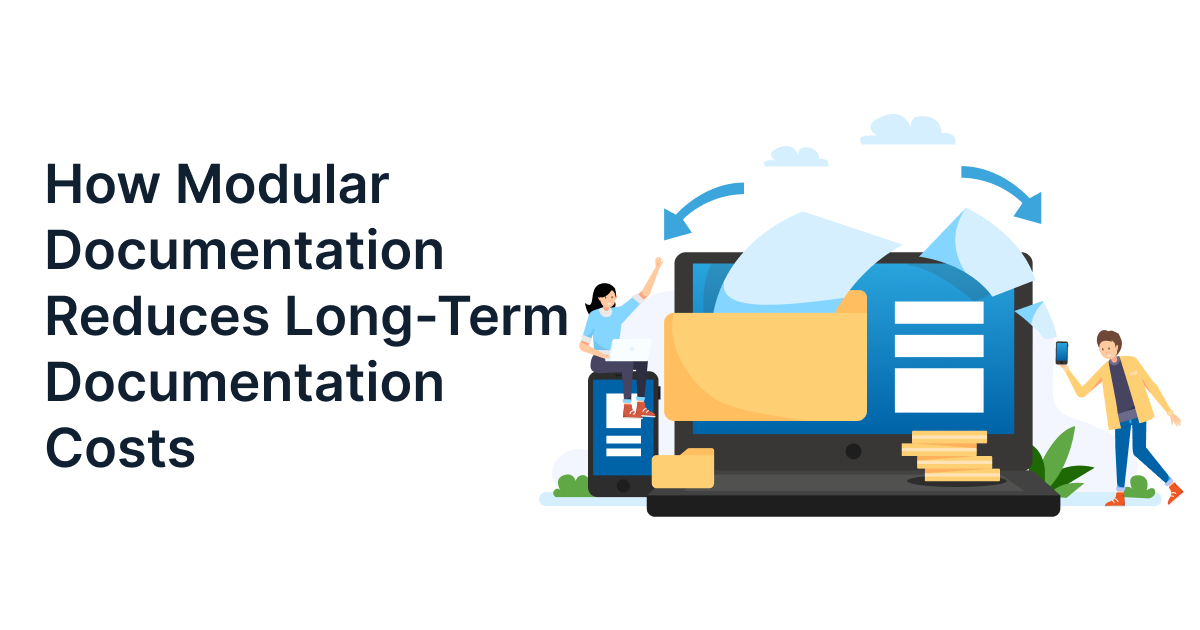
To reduce long-term documentation costs, you need to adopt modular documentation, breaking content into reusable components, managing it within a documentation management system & publishing it efficiently across formats through single source publishing.
In today’s landscape of digital transformation in engineering, organisations are re-evaluating how they create, manage & scale technical content. Documentation is no longer just a support function, it is a critical operational asset tied directly to efficiency, compliance & customer experience.
However, companies delivering advanced engineering solutions often face rising documentation costs due to duplicated efforts, inconsistent updates & inefficient publishing cycles. Traditional documentation models simply cannot scale with modern product complexity.
This is where modular documentation becomes a strategic advantage. By shifting toward reusable, structured content, organisations can dramatically reduce operational overhead while improving accuracy and speed.
Businesses looking to modernise their documentation workflows often begin by exploring specialised technical publication services that enable structured, scalable & cost-efficient approaches.

Key Insight
To reduce documentation costs effectively, you need modular documentation, a structured approach that divides content into reusable components managed through a centralised system.
Modular documentation transforms traditional linear documents into smaller, independent content units or modules. These modules are stored in a component content management system (CCMS) and can be reused across multiple documents, formats & languages.
Why This Matters for Cost Reduction –
Instead of rewriting the same instructions across manuals, teams can reuse approved modules, reducing writing time significantly.
A single update to a module automatically reflects across all documents where it is used, eliminating repetitive revision work.
Duplicate content is eliminated, ensuring lean and efficient documentation systems.
Writers can assemble documents by combining existing modules instead of starting from scratch.
This approach aligns perfectly with digital transformation in engineering, where scalability and speed are essential.
To reduce documentation costs in measurable ways, you need modular documentation that eliminates duplication, simplifies maintenance & enables automation across content workflows.
1. Eliminates Content Duplication
In traditional documentation, identical or similar content is often recreated multiple times across different manuals.
With modular documentation –
This results in significant savings in authoring time and resource allocation.
2. Reduces Maintenance and Update Costs
Updating traditional documents requires manual edits across multiple files, increasing the risk of inconsistencies.
With modular content –
Resulting in faster updates and reduced maintenance effort.
3. Minimises Translation and Localisation Costs
Translation is one of the most expensive parts of documentation.
With modular documentation –
Result: Up to 40% reduction in localisation costs.
4. Enables Efficient Single Source Publishing
Formatting and publishing documents in multiple formats is time-consuming.
With single source publishing –
Result: Reduced publishing time and lower production costs.
To improve efficiency and maximise ROI, you need structured documentation that standardises content creation and supports modular frameworks.
Structured documentation ensures that content follows predefined templates, tagging systems & metadata standards. This predictability enhances usability and reuse.
Key Benefits –
Everyone follows the same structure, reducing inconsistencies and improving quality.
Tagged and structured modules are easier to search and retrieve, saving time.
Multiple writers can work simultaneously without overlapping efforts.
Structured documentation integrates seamlessly with PLM, ERP & MES systems.
This is especially critical for organisations delivering advanced engineering solutions, where documentation must be accurate, synchronised & scalable.
For example, modern workflows are increasingly influenced by AI. You can explore how automation is shaping documentation in this article on AI in technical documentation workflows.
To implement modular documentation successfully, you need a documentation management system that centralises content, controls versions & enables efficient reuse.
A documentation management system, often a CCMS, acts as the backbone of modular documentation.
Core Capabilities –
Traditional vs Modular Documentation
| Feature | Traditional Documentation | Modular Documentation |
| Content Creation | Repetitive | Reusable modules |
| Maintenance | Manual updates | Centralised updates |
| Publishing | Format-specific | Single source publishing |
| Cost Efficiency | Low | High |
| Scalability | Limited | Highly scalable |
To scale documentation efficiently while reducing costs, you need single source publishing that allows content to be created once and delivered across multiple outputs.
Single source publishing ensures that teams do not recreate content for different platforms.
Advantages –
This becomes even more powerful when integrated with enterprise systems. Learn how in this blog on integrating technical publications with ERP/MES systems.
To evaluate cost reduction, you need to track measurable metrics such as time savings, translation efficiency & content reuse rates enabled by modular documentation.
Key Statistics –
According to IBM Documentation, organisations using structured content see up to 50% cost reduction
To enable digital transformation in engineering, you need modular documentation that integrates with digital ecosystems and supports data-driven workflows.
Modern engineering environments rely on –
Modular Documentation Enables –
These capabilities are essential for organisations offering advanced engineering solutions, where documentation must evolve alongside product innovation.
To understand its impact, you need to explore how modular documentation is applied across real-world engineering use cases.
Common Applications –
For a deeper understanding of engineering documentation types, explore this guide on common technical publications in engineering industries.
To successfully adopt modular documentation, you need to address challenges like implementation complexity, training requirements & content restructuring.
Key Challenges –
Practical Solutions –
To future-proof your documentation strategy, you need modular documentation supported by structured documentation, a robust documentation management system & single source publishing capabilities.
As digital transformation in engineering continues to reshape industries, documentation must evolve from static, siloed content to dynamic, reusable systems.
Modular documentation not only reduces costs but also improves accuracy, speeds up delivery & enhances scalability. For companies delivering advanced engineering solutions, this approach is no longer optional, it’s essential for long-term competitiveness.
If you’re ready to transform your documentation strategy and reduce costs, connect with experts at Katalyst Engineering to explore tailored solutions.

1. What is modular documentation in simple terms?
Modular documentation is the practice of creating content in smaller, reusable sections instead of long documents. These modules can be reused across multiple manuals, improving efficiency and reducing duplication.
2. How does modular documentation reduce documentation costs?
It reduces costs by eliminating redundant content creation, simplifying updates, lowering translation expenses & enabling automated publishing through single source systems.
3. What is a documentation management system?
A documentation management system is a platform that stores, organises & manages content modules, enabling version control, collaboration & efficient reuse.
4. What is structured documentation?
Structured documentation uses predefined templates and tagging systems, making content easier to manage, reuse & publish across multiple platforms.
5. What is single source publishing?
Single source publishing allows content to be created once and automatically published across different formats like PDFs, websites & mobile applications.
6. Which industries benefit most from modular documentation?
Industries like manufacturing, automotive, aerospace & engineering benefit significantly due to complex documentation needs.
7. What is acomponentcontent management system (CCMS)?
A CCMS is a tool that manages modular content, allowing organisations to reuse components across documents and streamline publishing workflows.
8. Is modular documentation suitable for small teams?
Yes, even small teams can benefit by reducing redundant work, improving consistency & increasing productivity with reusable content modules.

Senior Vice President, Katalyst Engineering
Bhavik Shah is the Vice President of Global Engineering and Manufacturing at Katalyst Engineering, with over 22 years of experience in the engineering industry. He specializes in product development, R&D, and engineering delivery operations, driving innovative, design-led solutions across automotive, industrial, and off-highway sectors. Bhavik plays a key role in strengthening engineering strategies, building global partnerships, and delivering high-performance outcomes for clients.