At Katalyst Engineering Services, we continually strive to drive innovation by deftly utilizing these resources, changing the issues encountered by various industries and fields with potential solutions.
At Katalyst Engineering Services, we continually strive to drive innovation by deftly utilizing these resources, changing the issues encountered by various industries and fields with potential solutions.

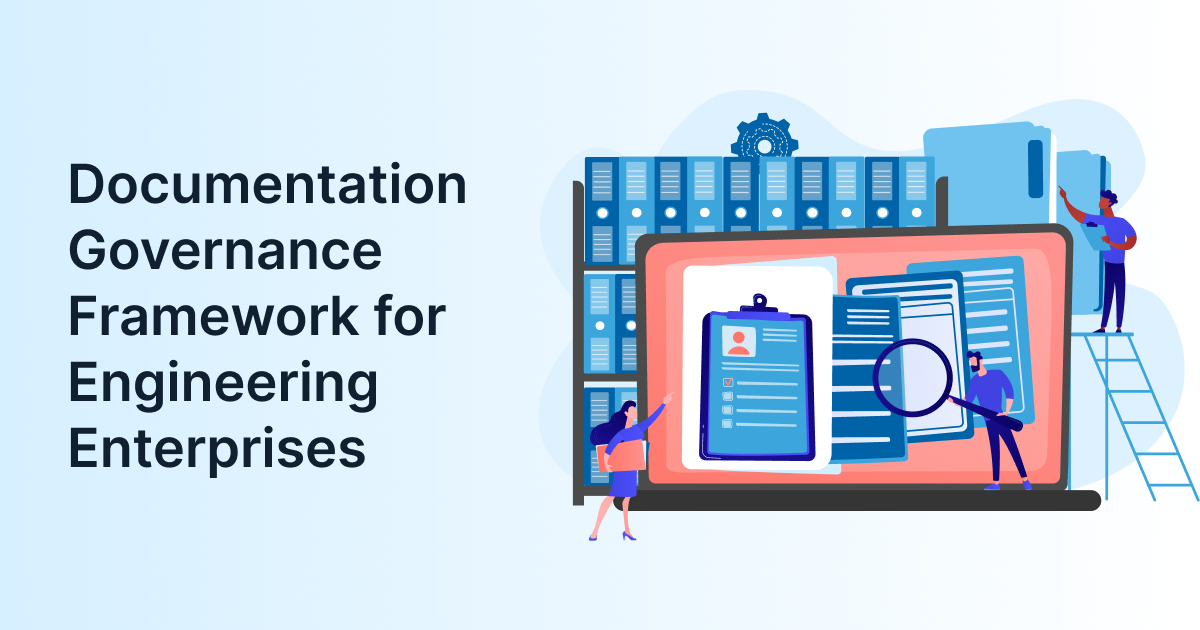
To ensure consistency, compliance & scalability, engineering enterprises need a structured documentation governance framework that standardises processes, enforces document lifecycle management & integrates advanced tools. This strengthens engineering documentation management while enabling digital transformation in engineering and advanced engineering solutions.
In modern engineering environments, documentation directly influences compliance, efficiency & customer outcomes. Without structured documentation governance, enterprises face fragmented documentation process workflows and inconsistent documentation standards. A robust technical documentation framework, supported by a scalable document control system, ensures accuracy and collaboration across teams.
Organisations looking to accelerate this transformation often rely on expert-led technical publication services, making this a strategic entry point in your documentation governance journey.

To maintain compliance, efficiency & accuracy across projects, you need documentation governance that standardises documentation standards and centralises engineering documentation management. This ensures all teams work with consistent, validated & up-to-date information.
Engineering organisations handle complex, multi-stage workflows involving design, manufacturing & service teams. Without governance, documentation becomes inconsistent and difficult to manage, leading to delays, compliance risks & operational inefficiencies.
1. How does documentation governance improve compliance?
A structured documentation governance framework ensures that all documents adhere to regulatory standards such as ISO 19650 and industry-specific compliance guidelines. This reduces audit risks and ensures traceability across projects.
For example, ISO-aligned document control ensures proper naming, approval workflows & version history.
2. How does it improve operational efficiency?
Documentation governance eliminates redundant documentation efforts and ensures a streamlined documentation process. Teams spend less time searching for correct versions and more time executing engineering tasks.
According to McKinsey, poor data and process management can reduce productivity by up to 20–30% in engineering operations.
To implement effective documentation governance, you need a structured framework that defines documentation standards, ownership, document lifecycle management & enabling technologies. This framework ensures consistency and scalability in engineering documentation management.
1. Documentation standards: Why are they the foundation?
To ensure consistency across engineering outputs, you need clearly defined documentation standards that govern formatting, metadata, naming conventions & content structure.
These standards make it easier for teams to understand and use documentation across departments and geographies. Without them, documentation becomes fragmented and difficult to scale.
2. Ownership and accountability: Who manages documentation?
To ensure accountability, you need clearly defined roles across the documentation process, including authors, reviewers, approvers & content owners.
This prevents workflow bottlenecks and ensures documents move efficiently through validation stages while maintaining quality.
3. Document lifecycle management: How is documentation controlled?
To maintain accuracy and audit readiness, you need structured document lifecycle management that governs creation, validation, revision & archiving.
A controlled lifecycle ensures that –
4. Technology enablement: What tools are required?
To scale governance, you need tools such as a document control system and engineering content management platforms that automate versioning, approvals & access control.
These tools also integrate with PLM, ERP & CAD systems. Supporting digital transformation in engineering initiatives.
To ensure consistency and traceability, you need document lifecycle management that governs how documents are created, reviewed, distributed, updated & archived across engineering workflows.
1. Creation: How do you ensure consistency from the start?
Documents should be created using predefined templates aligned with documentation standards. This ensures uniformity and reduces onboarding time for new engineers.
Templates also embed compliance requirements directly into the documentation process.
2. Review and approval: How do you ensure accuracy?
A structured review process ensures subject matter experts validate technical accuracy before documents are approved. This reduces downstream errors and rework.
3. Controlled distribution: How do you prevent outdated usage?
A document control system ensures documents are distributed only to authorised stakeholders with access to the latest versions, preventing errors caused by outdated documentation.
4. Revision management: How do you handle continuous updates?
Engineering changes require documentation updates. Version-controlled revisions ensure that changes are tracked, validated & implemented accurately.
5. Archival: Why is it critical for compliance?
Proper archival ensures that historical records are maintained for audits, legal requirements & future reference.
To build a robust technical documentation framework, you need to align governance policies, tools & workflows to ensure scalable engineering documentation management.
1. Define governance policies
Start by defining policies around documentation standards, access control, versioning & approval workflows. These policies form the backbone of documentation governance.
2. Implement a document control system
A document control system ensures version control, audit trails & workflow automation. It reduces manual errors and improves compliance visibility.
3. Centralise engineering content management
Centralised engineering content management ensures that all documentation is stored in a single repository, improving accessibility and reducing duplication.
4. Automate documentation workflows
Automation ensures faster approvals, fewer errors & improved efficiency in the documentation process.
5. Build a documentation culture
To sustain governance, teams must adopt structured documentation practices. This includes training, process adherence & accountability.
To enable effective documentation governance, you need tools that provide automation, analytics & control across documentation workflows.
Comparative view of tools
| Tool | Role in Governance | Strategic Value |
| Document Control System | Version control and compliance tracking | Reduces risk |
| Engineering Content Management | Centralised storage | Improves collaboration |
| Workflow Automation | Process efficiency | Faster approvals |
| Analytics Tools | Data insights | Optimise documentation |
Modern organisations are also adopting analytics-led documentation strategies. For example, improving manuals using usage data is explored in this guide on data-driven documentation.
To enable digital transformation in engineering, you need documentation governance that ensures structured, accurate & accessible data across systems.
Strategic contributions explained
To maximise business value, you need documentation governance that ensures accurate and consistent information flows across the entire product lifecycle. This helps engineering outputs translate smoothly into service, maintenance & customer-facing functions.
In practice, poor documentation often causes more downstream inefficiencies than the product itself. A structured documentation governance framework helps eliminate this gap by ensuring all teams work with validated, up-to-date content.
When documentation is outdated or inconsistent, service teams may follow incorrect procedures, leading to repeat repairs and higher warranty claims. With controlled document lifecycle management, organisations ensure that only approved and current instructions are used.
This relationship between documentation quality and service outcomes is also highlighted in the role of technical publications in warranty reduction strategies, where structured documentation improves service accuracy.
Aftermarket functions depend heavily on manuals and parts catalogues. Without governance, these documents can quickly fall out of sync with product updates.
A strong engineering content management approach ensures that spare parts documentation remains aligned with the latest configurations. This improves service turnaround time and parts identification, similar to what is discussed in how technical publications support aftermarket services and spare parts sales.
Clear documentation directly affects how customers interact with a product. Structured documentation standards and a consistent documentation process ensure manuals are easy to understand and use.
Many organisations are also improving documentation quality through user insights, as explored in data-driven documentation using analytics to improve user manuals, where data helps refine content based on real usage patterns.
To implement effective documentation governance, you need to overcome a few core challenges related to standardisation, systems & adoption. These challenges often slow down even well-planned initiatives.
Lack of standardisation
Teams often follow different formats and practices, which leads to inconsistent documentation. Without clear documentation standards, it becomes difficult to maintain quality and scale across projects.
Fragmented tools and systems
Using multiple disconnected tools creates silos in the documentation process. This results in duplicate files, version confusion & limited visibility.
Implementing a centralised document control system and unified engineering content management helps bring structure and consistency.
Resistance to structured processes
Teams may resist governance frameworks as they introduce new workflows. Without proper onboarding, documentation governance can feel restrictive rather than helpful.
Encouraging adoption requires demonstrating value, such as reduced rework and faster access to accurate information.
Lack of ownership
When roles are unclear, documents often remain outdated or delayed in approvals. A well-defined documentation process with clear ownership ensures accountability and timely updates.
Scalability limitations
As operations grow, manual documentation processes become inefficient. Without automation and governance, maintaining consistency across teams becomes challenging.
This is where structured workflows and systems play a key role in supporting digital transformation in engineering and scaling advanced engineering solutions effectively.

A well-defined documentation governance framework is essential for engineering enterprises aiming to improve efficiency, compliance & scalability. By implementing structured engineering documentation management, robust document lifecycle management & advanced tools, organisations can drive measurable improvements and support digital transformation in engineering and advanced engineering solutions.
To build a future-ready documentation ecosystem, connect with Katalyst Engineering and transform your documentation strategy into a competitive advantage.
1. What is documentation governance in engineering?
Documentation governance refers to structured policies, processes & tools used to manage engineering documentation throughout its lifecycle. It ensures consistency, accuracy & compliance while enabling efficient collaboration between teams and stakeholders.
2. Why is engineering documentation management important?
Engineering documentation management ensures that all documents are accurate, accessible & updated. It helps reduce errors, improve efficiency & maintain compliance with industry standards.
3. What is a document control system?
A document control system is a tool used to manage document versions, approvals, and access. It ensures that teams always use the latest document and maintain proper audit trails.
4. How does document lifecycle management work?
Document lifecycle management governs the entire lifecycle of documents, from creation to archival, ensuring consistency, traceability & compliance.
5. What are documentation standards?
Documentation standards define formatting, naming conventions & quality benchmarks. They ensure uniformity across all engineering documents.
6. How does documentation governance support digital transformation?
It ensures structured data, automation, and integration required for digital workflows, making it a key enabler of digital transformation in engineering.

Senior Vice President, Katalyst Engineering
Bhavik Shah is the Vice President of Global Engineering and Manufacturing at Katalyst Engineering, with over 22 years of experience in the engineering industry. He specializes in product development, R&D, and engineering delivery operations, driving innovative, design-led solutions across automotive, industrial, and off-highway sectors. Bhavik plays a key role in strengthening engineering strategies, building global partnerships, and delivering high-performance outcomes for clients.