At Katalyst Engineering Services, we continually strive to drive innovation by deftly utilizing these resources, changing the issues encountered by various industries and fields with potential solutions.
At Katalyst Engineering Services, we continually strive to drive innovation by deftly utilizing these resources, changing the issues encountered by various industries and fields with potential solutions.

Imagine, a turbine trips at 2 a.m. The control-room team needs the correct shutdown sequence, alarm interpretation, isolation steps, and restart criteria. If those details live in an outdated PDF, a supplier portal, or someone’s memory, the outage lasts longer than it should.
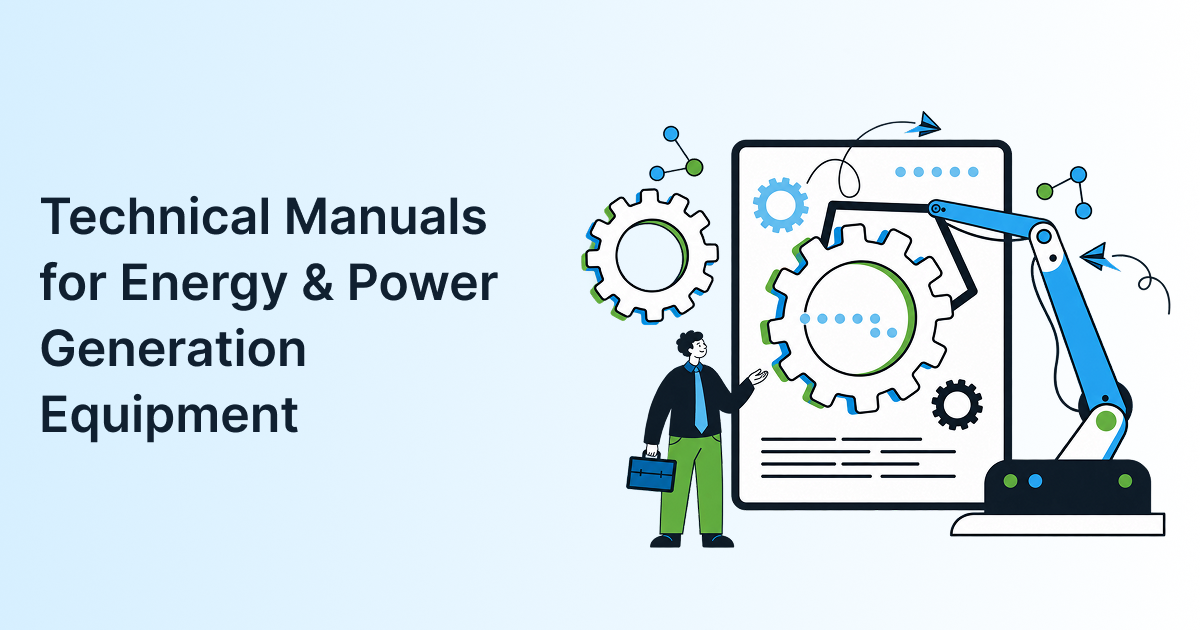
That is the practical value of technical manuals for energy and power generation equipment. They turn engineering knowledge into instructions that operators, technicians, and maintenance planners can use when equipment is running, failing, or being serviced. Strong documentation is especially important in power generation, where equipment availability, safety, and regulatory readiness depend on consistent procedures.
Katalyst Engineering’s technical publication services support manufacturers and industrial teams that need accurate manuals, service documentation, work instructions, parts catalogs, and digital publications. The goal is not simply to produce documents; it is to make equipment knowledge usable at the point of work.
Technical manuals decide how consistently people operate and maintain equipment. A good manual reduces variation between shifts, helps technicians diagnose problems faster, and preserves knowledge that would otherwise leave with experienced staff.
Power-generation assets, turbines, generators, boilers, transformers, switchgear, inverters, balance-of-plant systems, and control systems, often remain in service for decades. Over that time, personnel change, suppliers change, controls are upgraded, and equipment is modified. Without controlled documentation, the plant gradually operates from incomplete or conflicting information.
Did you know?
IAEA guidance treats maintenance documentation as a broad set of supporting information, including schedules, procedures, work packages, records, manuals, and drawings needed for safe and effective plant maintenance.
The U.S. Energy Information Administration reported 39 unplanned nuclear generation outages as of October 21, 2024, compared with 55 during 2023. Equipment failure and operational error are among the causes of these outages. While documentation alone cannot prevent equipment failures, accurate and current procedures can help personnel respond consistently and avoid errors during operation and maintenance.
A complete technical manual set should include operating instructions, maintenance procedures, safety requirements, drawings, spare-parts information, commissioning records, and a controlled change history. For power-generation equipment, these documents need to work together, not sit in separate folders with no connection.
A useful way to think about the set is by question:
| User | Core question | Primary documentation |
| Operator | How do I start, run, shut down, and respond to alarms? | Operation manual, operating procedures, alarm-response guidance |
| Maintenance technician | How do I inspect, test, repair, and return equipment to service? | Maintenance manual, work instructions, test procedures |
| Planner | What parts, tools, intervals, and prerequisites do the job require? | Spare-parts catalog, preventive-maintenance plan, task lists |
| Engineer | What was installed, configured, modified, and validated? | As-built drawings, specifications, commissioning records, change log |
| Safety and compliance team | What hazards, permits, and controls apply? | Safety procedures, lockout/tagout requirements, compliance references |
This structure prevents the common problem of a beautifully written manual that nobody can find during an outage.
Operation manuals should cover normal startup, normal operation, planned shutdown, emergency shutdown, alarm response, and recovery after a trip. They should also state operating limits clearly: temperatures, pressures, speeds, vibration thresholds, electrical parameters, and interlock behavior.
For example, a gas-turbine operation manual should not merely list alarm codes. It should explain what the operator should check first, which conditions require immediate shutdown, which require engineering review, and what information to record for the maintenance team.
The test is simple: can a qualified operator follow the approved procedure for the stated operating condition, understand when escalation is required, and identify when OEM or engineering support is necessary?
Maintenance manuals should support the full work cycle: prerequisites, isolation, inspection, disassembly, repair or replacement, reassembly, testing, and return to service. They should identify required tools, torque values, consumables, calibration requirements, acceptance criteria, and safety holds.
The IAEA recommends that maintenance instructions be clear, unambiguous, technically accurate, and written in language technicians understand. It also recommends step-by-step instructions, especially for complex or high-risk work. That guidance applies directly to turbines, generators, boilers, switchgear, and other power-generation assets.
A practical rule is to keep each step focused on one main action or a clearly connected sequence of actions. Separate safety-critical checks, measurements, and acceptance decisions so technicians can verify them without ambiguity.
Drawings, parts data, and commissioning records are not optional attachments. They are the evidence base behind every procedure.
A strong documentation package includes electrical single-line diagrams, wiring diagrams, P&IDs where relevant, equipment datasheets, installed-component records, serial numbers, protection settings, control-system configurations, factory acceptance test records, and commissioning results. NREL’s O&M guidance similarly identifies as-built drawings, specifications, schematics, component data, warranties, operating manuals, and commissioning records as core system documentation.
For an equipment manufacturer, the most valuable addition is a change history: what changed, when, why, who approved it, and which documents were affected.
Structure manuals around the task, not around the engineering organization. A technician facing a bearing issue should reach the relevant procedure in a few clicks, not search through a 400-page PDF organized by drawing number.
A plant-floor-friendly manual usually has:
If you are wondering where to start, the short answer is: document the highest-consequence tasks first. Startup and shutdown sequences, emergency response, lockout/tagout, critical alarms, high-energy work, and return-to-service testing deserve the most attention.
This is also where documentation management matters. Many teams do not lack manuals; they lack a dependable way to control versions, find the current procedure, and connect it to the correct asset. That challenge is common across manufacturing documentation programs, as discussed in Katalyst’s article on managing technical documentation challenges.
Legacy equipment is difficult because the equipment, the controls, and the documentation have often changed independently. A turbine may have its original mechanical design, a replacement control system, revised protection settings, and several undocumented repairs.
The biggest mistake is treating legacy documentation as an OEM-manual problem. The original manual may describe equipment that no longer exists in its installed form. What the plant needs is “as-operated” documentation: the equipment as it is configured and used today.
For a mixed fleet, Katalyst’s perspective is straightforward: prioritize documentation by operational risk, not by document age. A 20-year-old auxiliary pump with a clear procedure and low failure impact may need less urgent work than a five-year-old critical system whose controls were modified without updated drawings.
A practical reconstruction sequence is:

Maintenance data improves manuals by showing which procedures are unclear, incomplete, or frequently used. Work orders, failure reports, inspection findings, alarm histories, and technician feedback reveal where documentation needs attention.
For instance, if the same troubleshooting path appears repeatedly in work orders for a cooling-water system, the manual may need a clearer diagnostic sequence. If technicians routinely call engineering before performing a particular test, the procedure may be missing a prerequisite, tool reference, or acceptance criterion.
This is where data-driven documentation becomes practical. Instead of revising manuals on a fixed calendar alone, teams can review recurring failures, repeat work orders, procedure deviations, and near misses. Katalyst explores this approach further in its article on using analytics to improve user manuals.
The important discipline is to distinguish correlation from cause. A recurring alarm may indicate a documentation gap, but it may also indicate a sensor problem, an operating-pattern issue, or an aging component. The manual revision should follow engineering review, not replace it.
The highest-risk mistakes are usually not spelling errors or missing appendices. They are gaps that force people to improvise during abnormal conditions.
Common mistakes include:
The underlying issue is ownership. Every manual needs a named technical owner, a review cycle, and a defined trigger for updates.
Manual updates should be controlled through the same discipline used for engineering changes. Every revision needs a reason, an approver, an effective date, and a record of what changed.
At minimum, a change record should capture:
Electronic document management makes this easier, but the system alone is not the answer. The process must ensure that a revised drawing automatically raises the question: which procedures, work instructions, spare-parts lists, and training materials are affected?
This is one area where digital transformation in engineering can help. Linked documentation, searchable repositories, and controlled workflows reduce the chance that an obsolete drawing remains in circulation. But the value comes from disciplined change management, not from software alone.
Rebuild documentation when the existing material cannot be verified against the installed equipment or cannot support safe operation and maintenance. Missing manuals, conflicting drawings, unknown control logic, and repeated procedure deviations are warning signs.
Rebuilding everything at once is rarely practical. A risk-based approach works better:
| Priority | Equipment profile | Documentation action |
| Immediate | Safety-critical, high-energy, or outage-critical equipment with missing or conflicting procedures | Reconstruct and validate urgently |
| Near term | Critical equipment with incomplete drawings, unknown settings, or frequent troubleshooting gaps | Reconcile configuration and revise procedures |
| Scheduled | Stable equipment with usable but outdated documents | Review, update, and standardize |
The objective is not perfect documentation for every asset. It is dependable documentation where failure, confusion, or delay would matter most.
AI can support technical manual development by accelerating drafting, consistency checks, terminology cleanup, translation preparation, and content reuse. It can help turn engineering inputs into structured first drafts, identify missing prerequisites, and flag inconsistent terminology across documents.
It should not replace engineering validation. An AI-generated procedure may read well and still be wrong for the installed configuration. Every safety step, operating limit, torque value, interlock behavior, and acceptance criterion needs review by someone accountable for the equipment.
A sensible workflow is engineer provides verified source information, AI helps structure and standardize the draft, technical reviewers validate the content, and the document enters controlled release. Katalyst discusses this balance in its article on AI’s impact on technical documentation workflows.
If you are considering AI, start with low-risk, high-volume work: terminology alignment, formatting, cross-reference checks, and first-draft structuring. Keep safety-critical content under direct engineering control.

Strong technical manuals do not just describe equipment; they protect availability, safety, and institutional knowledge across the life of a power-generation asset. The most effective programs treat documentation as living engineering content, validated against the installed plant, updated after every modification, and improved using feedback from the people who use it.
If your team is dealing with outdated manuals, missing legacy documentation, or inconsistent procedures across a fleet, talk through your documentation needs with Katalyst Engineering. A short conversation can help you decide where to start and which equipment documentation deserves attention first.
1. What is the difference between an operation manual and a maintenance manual?
An operation manual tells operators how to start, run, monitor, shut down, and respond to abnormal conditions. A maintenance manual tells technicians how to inspect, test, repair, and return equipment to service. Both should share consistent equipment names, drawings, safety requirements, and revision control.
2. What should be included in power plant operation and maintenance documentation?
It should include operating procedures, alarm-response guidance, maintenance procedures, preventive-maintenance schedules, troubleshooting steps, safety requirements, drawings, spare-parts information, commissioning records, and a change history. The exact depth depends on equipment criticality, regulatory requirements, and the plant’s operating model.
3. How often should technical manuals be updated?
Update them whenever equipment, controls, drawings, safety requirements, or operating limits change. Also review them on a defined cycle, especially for safety-critical systems. A fixed review schedule is useful, but modification-triggered updates are more important.
4. Why are as-built drawings important for maintenance manuals?
As-built drawings show the equipment as actually installed, including modifications made during construction, commissioning, or later upgrades. Without them, technicians may follow a procedure based on an outdated configuration, which can lead to incorrect isolation, wrong parts, or unsafe work.
5. Can AI write technical manuals for power-generation equipment?
AI can draft, structure, standardize, and check technical manuals, but it should not independently create safety-critical content. Engineering teams must verify operating limits, control logic, maintenance steps, torque values, and acceptance criteria against the actual equipment configuration.
6. What is the first step in improving poor equipment documentation?
Start with a documentation gap assessment. Identify critical equipment, review the current procedures and drawings, compare them with the installed configuration, and prioritize gaps by safety and operational risk. Then improve the highest-risk documents before attempting a full documentation overhaul.

Senior Vice President, Katalyst Engineering
Bhavik Shah is the Vice President of Global Engineering and Manufacturing at Katalyst Engineering, with over 22 years of experience in the engineering industry. He specializes in product development, R&D, and engineering delivery operations, driving innovative, design-led solutions across automotive, industrial, and off-highway sectors. Bhavik plays a key role in strengthening engineering strategies, building global partnerships, and delivering high-performance outcomes for clients.