At Katalyst Engineering Services, we continually strive to drive innovation by deftly utilizing these resources, changing the issues encountered by various industries and fields with potential solutions.
At Katalyst Engineering Services, we continually strive to drive innovation by deftly utilizing these resources, changing the issues encountered by various industries and fields with potential solutions.

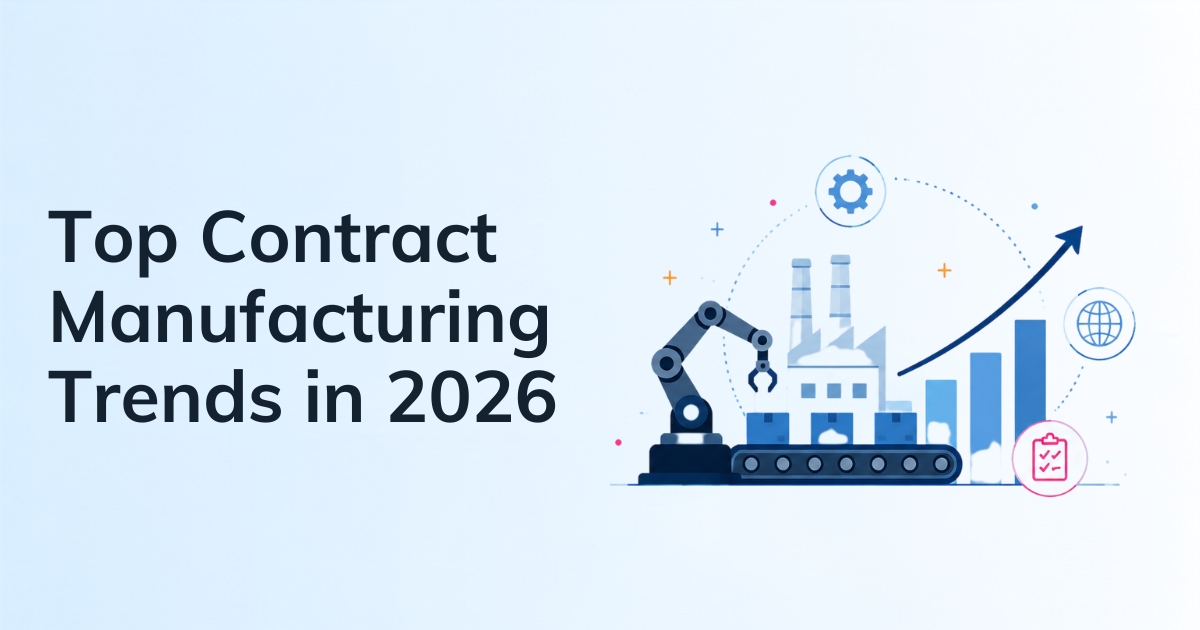
As global supply chains continue to evolve, contract manufacturing trends in 2026 are centred around smart factories, AI-driven production, supply chain resilience, and sustainability. Companies are increasingly leveraging advanced manufacturing technologies, automation, and digital engineering to improve efficiency, reduce costs, and accelerate product innovation. These trends are transforming how manufacturers collaborate, scale production, and meet changing market demands.
The manufacturing landscape is entering a new phase of transformation. Rising product complexity, labour shortages, geopolitical uncertainty, and growing sustainability requirements are forcing manufacturers to rethink traditional production models. As a result, organisations are increasingly turning to contract manufacturing services powered by digital manufacturing, smart manufacturing, and advanced engineering capabilities. For businesses seeking scalability and operational excellence, these developments represent significant opportunities to optimise production while maintaining quality and speed to market.
If you’re exploring outsourced production capabilities, partnering with experienced providers offering manufacturing engineering services can help accelerate digital adoption while improving production efficiency and product quality.

To remain competitive in increasingly volatile markets, manufacturers need greater flexibility, visibility, and speed than ever before. This requirement is driving investment in digital transformation, automation, and collaborative production models that support rapid scalability.
Several factors are influencing current manufacturing industry trends –
The result is a shift toward highly connected manufacturing ecosystems that rely on data-driven decision-making and advanced engineering solutions.
To improve operational efficiency and production agility, manufacturers are increasingly implementing smart manufacturing systems that connect machines, people, and processes through real-time data.
Smart manufacturing combines –
Through these technologies, contract manufacturers can identify production bottlenecks, optimise machine utilisation, and reduce downtime before problems occur.
This trend also supports broader digital transformation in engineering initiatives by enabling engineering and production teams to collaborate using real-time operational insights.
Key Statistics: Contract Manufacturing and Manufacturing Industry Trends
According to Grand view Research industry analysis, the global smart manufacturing market is projected to exceed USD 450 billion by 2030, driven by Industry 4.0 adoption.
To deliver faster product development cycles and improve production accuracy, contract manufacturers are investing heavily in digital manufacturing technologies.
Digital manufacturing integrates digital tools throughout the product lifecycle, including:
Digital manufacturing enables manufacturers to test production scenarios virtually before physical deployment. This reduces costs, shortens development timelines, and improves production reliability.
Many organisations pursuing digital transformation in engineering are using digital manufacturing environments to create seamless collaboration between engineering, design, and production teams.
To remain competitive, manufacturers are incorporating advanced manufacturing technologies that improve productivity, accuracy, and manufacturing flexibility.
Artificial Intelligence and Machine Learning
AI-powered systems analyse production data to identify quality issues, optimise workflows, and improve forecasting accuracy.
Digital Twins
Digital twins create virtual replicas of manufacturing environments, allowing organisations to simulate performance and optimise operations before physical implementation.
Additive Manufacturing
3D printing technologies continue to expand beyond prototyping into production-scale applications for specialised components.
Industrial Internet of Things (IIoT)
Connected machines provide real-time visibility into production performance, inventory levels, and equipment health.
These advanced manufacturing technologies are becoming essential differentiators among leading contract manufacturers.
To address labour shortages and improve consistency, manufacturers are accelerating investments in manufacturing automation across production facilities.
Manufacturing automation now extends far beyond simple robotics. Modern automation includes –
Automation improves –
Contract manufacturers that combine automation with advanced engineering solutions can deliver greater operational efficiency while supporting complex product requirements.
Did You Know? According to Deloitte’s Smart Manufacturing Survey, manufacturers with smart factory initiatives reported an average 10% to 12% increase in production output, factory utilisation, and labour productivity. |
To minimise operational disruptions, manufacturers are redesigning supply chains with greater flexibility and geographic diversification.
Recent global disruptions have highlighted the risks associated with overreliance on single-source suppliers.
Key resilience strategies include –
Contract manufacturing partners now play a strategic role in helping organisations build more resilient production networks.
For additional insights into outsourcing strategies, businesses can explore Six Reasons to Consider Contract Manufacturing Services, which highlights key operational and cost advantages of external manufacturing partnerships.

To meet regulatory requirements and customer expectations, manufacturers must integrate sustainability into every stage of production.
Sustainability initiatives include –
Environmental performance is becoming an important evaluation criterion when selecting contract manufacturing services providers.
Manufacturers that adopt sustainable production strategies often strengthen brand reputation while achieving long-term cost savings.
To manage increasing product complexity and shorter development cycles, companies are relying on advanced engineering solutions to improve design, validation, and production readiness.
Today’s engineering teams support contract manufacturing through:
As digital transformation in engineering accelerates, engineering expertise is becoming a strategic competitive advantage rather than a supporting function.
This trend closely aligns with findings discussed in Contract Manufacturing: Benefits, Challenges, and Future Trends, where evolving technology adoption is highlighted as a key driver of future manufacturing competitiveness.
To support increasingly dynamic markets, future contract manufacturing models will become more intelligent, connected, and collaborative.
The future of contract manufacturing will likely include –
| Trend Area | Expected Impact |
| AI-Driven Operations | Autonomous decision-making and optimisation |
| Smart Manufacturing Ecosystems | Greater connectivity across suppliers and partners |
| Digital Engineering Integration | Faster product development cycles |
| Predictive Supply Chains | Improved resilience and forecasting |
| Sustainable Production | Reduced environmental impact |
| Hyper-Automation | Enhanced productivity and scalability |
Manufacturers that embrace these changes early will be better positioned to handle evolving customer requirements and market challenges.
This shift demonstrates why advanced engineering solutions and digital transformation in engineering have become fundamental pillars of modern manufacturing success.
The top contract manufacturing trends in 2026 reflect a broader transformation across global manufacturing. From smart manufacturing and digital manufacturing to AI, manufacturing automation, and sustainability initiatives, contract manufacturers are becoming strategic innovation partners rather than simply production providers.
Organisations that invest in advanced manufacturing technologies, adopt data-driven operations, and leverage advanced engineering solutions will be best positioned to improve efficiency, accelerate innovation, and build resilient manufacturing ecosystems.
Looking to optimise your production processes and accelerate digital transformation initiatives? Connect with our engineering experts to explore tailored manufacturing solutions.
1. What are the top contract manufacturing trends in 2026?
The top contract manufacturing trends in 2026 include smart manufacturing, digital manufacturing, AI-driven production, manufacturing automation, digital twins, sustainable manufacturing practices, and resilient supply chain strategies. These developments are helping manufacturers improve efficiency, scalability, and operational agility.
2. Why is smart manufacturing becoming important for contract manufacturers?
Smart manufacturing enables real-time monitoring, predictive maintenance, and data-driven optimisation across production facilities. By connecting machines and systems, manufacturers can improve productivity, reduce downtime, and enhance quality control throughout operations.
3. How does digital manufacturing improve production performance?
Digital manufacturing integrates technology across design, engineering, planning, and production processes. This approach helps manufacturers simulate production environments, reduce errors, accelerate product development, and improve overall manufacturing efficiency.
4. What role does manufacturing automation play in 2026?
Manufacturing automation helps address labour shortages, increase production consistency, and reduce operational costs. Modern automation solutions include robotics, AI-powered inspection systems, and automated material handling technologies.
5. How are advanced manufacturing technologies changing the industry?
Advanced manufacturing technologies such as AI, digital twins, Industrial IoT, and additive manufacturing enable greater operational visibility, faster innovation, and improved production flexibility. These technologies support long-term competitiveness and resilience.
6. What is the future of contract manufacturing?
The future of contract manufacturing will focus on intelligent production systems, sustainable manufacturing, connected supply chains, and stronger integration between engineering and manufacturing. Contract manufacturers will increasingly function as strategic business partners.
7. How does digital transformation in engineering support contract manufacturing?
Digital transformation in engineering improves collaboration between design, engineering, and production teams. Technologies such as digital twins, simulation tools, and data-driven workflows help accelerate product development and optimise manufacturing outcomes.
8. How can businesses choose the right contract manufacturing partner?
Businesses should evaluate manufacturing expertise, quality systems, engineering capabilities, technology adoption, scalability, and supply chain resilience. Providers offering advanced engineering solutions and digital manufacturing capabilities are often better positioned to support long-term growth.

Senior Vice President, Katalyst Engineering
Bhavik Shah is the Vice President of Global Engineering and Manufacturing at Katalyst Engineering, with over 22 years of experience in the engineering industry. He specializes in product development, R&D, and engineering delivery operations, driving innovative, design-led solutions across automotive, industrial, and off-highway sectors. Bhavik plays a key role in strengthening engineering strategies, building global partnerships, and delivering high-performance outcomes for clients.