At Katalyst Engineering Services, we continually strive to drive innovation by deftly utilizing these resources, changing the issues encountered by various industries and fields with potential solutions.
At Katalyst Engineering Services, we continually strive to drive innovation by deftly utilizing these resources, changing the issues encountered by various industries and fields with potential solutions.

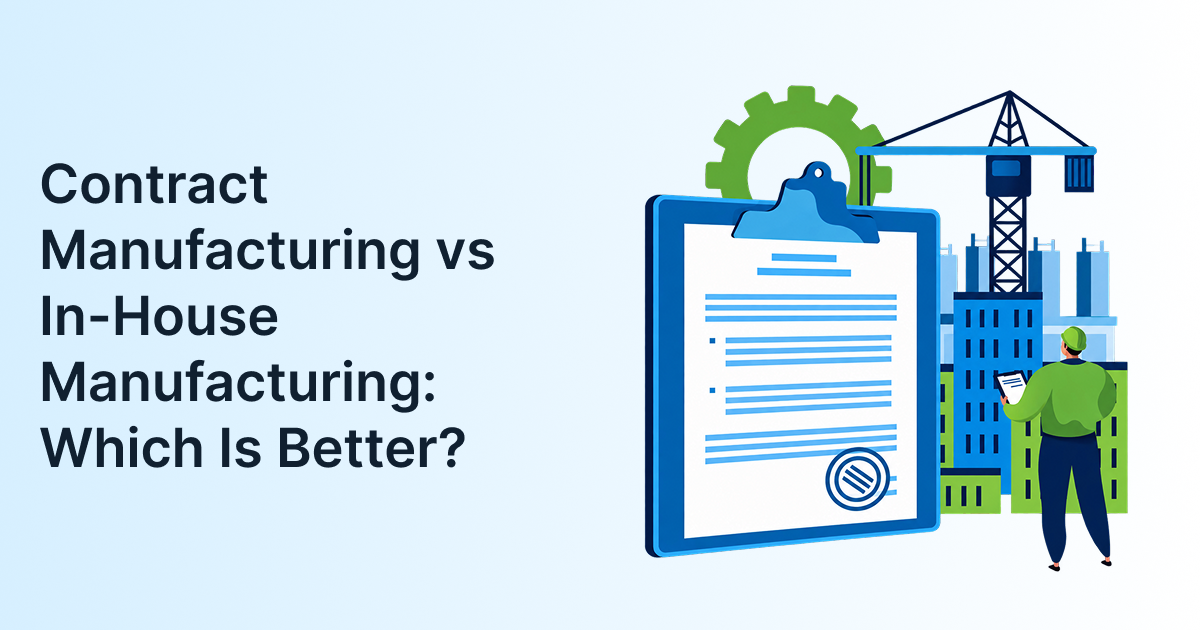
Contract manufacturing means hiring a third-party manufacturer to produce components or finished products according to your designs, specifications, and quality requirements. In-house manufacturing means owning and operating the facility, equipment, workforce, and production processes.
Neither option is automatically better. Contract manufacturing is usually more practical when you need flexibility, lower upfront investment, specialised capabilities, or faster scale. In-house manufacturing may be the stronger choice when production is highly predictable; process control is a competitive advantage, or volumes justify permanent infrastructure.
For many OEMs, the most effective answer is not choosing one model permanently. A hybrid approach can keep strategic or high-risk activities in-house while using an experienced manufacturing partner for specialised parts, capacity expansion, or production peaks.
If you are evaluating outsourced manufacturing for fabricated, machined, cast, forged, formed, or assembled components, Katalyst Engineering’s contract manufacturing services can help you assess production requirements before committing to a long-term model.
For many growing OEMs and industrial businesses, contract manufacturing can be a practical starting point when demand is uncertain, specialised capabilities are required, or building permanent infrastructure would add unnecessary capital exposure. In-house manufacturing can become more economical at stable, high volumes when the facility, workforce, and equipment remain consistently utilised.
Contract manufacturing is a production arrangement in which an external supplier manufactures products or components for another company. The customer generally retains ownership of the product design, brand, and technical requirements, while the manufacturing partner manages some or all of the production work.
Depending on the agreement, the contract manufacturer may provide –
This model is also closely connected with OEM manufacturing. OEM manufacturing describes production for an original equipment manufacturer; the manufacturing itself may be performed in-house or outsourced to a contract manufacturer, depending on the business model.
The exact division of responsibility should be defined before production begins. A clear agreement should cover drawings, tolerances, approved materials, inspection methods, tooling ownership, intellectual property, change control, delivery expectations, and non-conformance handling.
Katalyst Engineering’s service model covers fabrication, sheet metal, castings, forgings, machining, extrusions, hoses, gaskets, and related manufacturing requirements. This breadth can be useful when a product needs several production processes rather than a single component type.

In-house manufacturing means producing goods within facilities owned or controlled by the company. The business is responsible for the factory, machinery, employees, production planning, maintenance, quality systems, materials, compliance, and day-to-day operating decisions.
The main advantage is direct control. An internal team can change priorities quickly, observe production closely, and build specialised process knowledge over time. It can also protect sensitive manufacturing methods when the process itself is central to the company’s competitive position.
However, ownership brings fixed responsibilities. A company must invest in equipment and facilities even when demand is low. It must also recruit skilled employees, maintain machinery, manage safety requirements, qualify suppliers, and absorb downtime or underutilised capacity.
In-house production therefore works best when the business has –
The better choice depends on your production volume, cash position, product complexity, quality requirements, time-to-market expectations, and tolerance for operational risk. Contract manufacturing usually wins on flexibility and speed, while in-house production wins on direct control and internal process ownership.
| Decision factor | Contract manufacturing | In-house manufacturing |
| Upfront investment | Lower; uses an existing supplier base and facility | Higher; requires equipment, facilities, and hiring |
| Fixed overhead | Lower and more variable | Higher and ongoing |
| Production control | Managed through specifications, audits, and agreements | Direct day-to-day control |
| Scalability | Usually easier to increase or reduce capacity | Requires additional equipment, shifts, or facilities |
| Speed to production | Can be faster when the supplier already has qualified capacity and processes | Slower if new infrastructure is required |
| Specialist capability | Access to external expertise and equipment | Must be developed internally |
| Quality responsibility | Managed through specifications, qualification, inspection, audits, and supplier controls | Directly managed by the company |
| Best fit | Variable demand, new products, capacity gaps, specialised work | Stable volume, proprietary processes, high utilisation |
The comparison should not stop at the quoted unit price. A lower external price may be offset by logistics, tooling, inspection, supplier management, or minimum-order requirements. Likewise, an internal unit price may look attractive while excluding depreciation, maintenance, quality staff, utilities & unused capacity.
The right calculation is the total cost of ownership over the expected production period.
The main benefits of contract manufacturing are lower capital requirements, access to specialist capabilities, flexible capacity, and the ability to focus internal teams on design, engineering, sales, and product development.
Lower capital commitment
A company does not need to build an entire facility or purchase every machine required for production. This can preserve cash for product development, market expansion, testing, and working capital.
This does not mean contract manufacturing has no setup cost. Tooling, fixtures, prototypes, qualification runs, and engineering changes may still require investment. The difference is that the business avoids carrying out the full permanent infrastructure burden.
Faster access to production capability
An established supplier may already have the equipment, workforce, processes, and supplier relationships needed to manufacture a component. That can shorten the path from design release to production compared with building a new internal line.
This advantage is strong when the product uses familiar processes such as sheet metal fabrication, machining, welding, castings, or standard assembly methods.
Flexible capacity
Outsourced manufacturing can help companies respond to seasonal demand, new customer orders, or unexpected growth without immediately building another facility. It can also support smaller production runs while demand is still being validated.
For this reason, contract manufacturing is often useful for startups, SMEs, and established OEMs entering a new product category.
Access to specialised knowledge
A capable manufacturing partner can contribute practical feedback on tolerances, materials, tooling, assembly sequence, inspection, and production risk. That input can improve a design before it reaches full production.
This is where manufacturing strategy and engineering should work together. Design decisions made early can influence tooling cost, assembly time, scrap, repairability, and supplier availability. Katalyst Engineering’s guide to design for manufacturability in agricultural equipment explains how early design choices affect cost and production efficiency.
Reduced operational burden
A contract manufacturer may manage production labour, equipment maintenance, shop-floor scheduling, and some supplier coordination. The customer still needs strong oversight, but it does not have to build every operational function internally.
Contract manufacturing can introduce risks involving quality consistency, communication, intellectual property, lead times, supplier dependence, and visibility into production. These risks are manageable, but they should be addressed before the supplier is selected.
A proper supplier evaluation should examine –
Quality should not be treated as a final inspection activity alone. The agreement should define incoming inspection, in-process checks, first-article approval, process capability expectations, non-conformance reporting, corrective action, and change of approval.
Intellectual property also needs practical protection. Contracts should identify who owns drawings, tooling, fixtures, process documentation, and production improvements. Access to files should be limited, and unauthorised changes should require written approval.
A supplier that offers a low quote but cannot provide reliable documentation or transparent communication may create greater cost later through delays, rework, and field failures.
In-house manufacturing may be the better choice when production volumes are stable, equipment utilisation is high, and the process provides a strategic advantage that the business does not want to share externally.
It can also make sense when:
There is, however, a difference between wanting control and needing ownership. A company may obtain strong control through detailed specifications, supplier audits, digital production records, inspection plans, and regular performance reviews without owning the entire factory.
Before investing in equipment, calculate expected utilisation. A machine that runs only a small portion of the year may be more expensive than an external supplier, even if the internal labour rate appears lower.
OEMs should compare both models using the same product data, production forecast, quality requirements, and time horizons. The decision should be based on total business impact rather than an isolated per-unit price.
A practical evaluation can follow these questions:
A useful way to think about the decision is to separate production into three categories:
This framework often leads to a hybrid manufacturing strategy rather than an all-or-nothing decision.
The contract manufacturing market is expanding, but published estimates vary significantly because research firms use different definitions, sectors, and market boundaries. One market estimate values the global sector at approximately USD 724.35 billion in 2025 and projects it to reach USD 966.84 billion by 2030, representing a projected CAGR of 5.98%.
Contract manufacturing does not necessarily mean giving up ownership of your product. In a typical OEM arrangement, the customer retains its product design and brand while the external manufacturer produces agreed specifications. This distinction is important when evaluating outsourced manufacturing.
The broader lesson is not that every company should outsource production. It is that external manufacturing has become a strategic capacity option, especially for businesses that need to scale without committing immediately to permanent infrastructure.
Market-size figures should be used as context rather than as a guarantee of savings. Your own volume, process requirements, logistics, quality controls, and supplier relationships will determine whether contract manufacturing is commercially sensible.
As manufacturing becomes more connected and flexible, OEMs are also evaluating digital production systems, automation, predictive maintenance, and data-led supplier management. These developments are changing how companies approach production outsourcing and are discussed further in Katalyst Engineering’s article on emerging trends in contract manufacturing.
Companies can reduce outsourcing risk by starting with a clearly defined scope, validating the supplier through a pilot run, and setting measurable quality and delivery expectations.
A practical supplier transition should include:
A pilot project is valuable because it tests more than the supplier’s ability to make one part. It reveals how the partner communicates, documents issues, responds to engineering changes, manages packaging, and handles delivery pressure.
For companies considering outsourcing because internal teams are overloaded, Katalyst Engineering’s six reasons to consider a manufacturing partner provides additional context on capacity, cost, expertise, and operational focus.

A hybrid model can be better when a company needs direct control over critical work but also wants the capacity and flexibility of external production. It allows the business to retain strategic activities internally while outsourcing processes that are specialised, repetitive, or volume dependent.
For example, an OEM might keep product engineering, final testing, and sensitive prototype work in-house while using a contract manufacturer for fabricated frames, machined parts, castings, or sub-assemblies.
The model can also change over time. A new product may begin with outsourced manufacturing to validate demand. Once volumes become stable, the company may bring selected processes in-house. Conversely, an established business may outsource production when it needs to reduce capital pressure or enter a new market quickly.
The best decision is therefore not permanent. It should be reviewed as volume, product complexity, customer requirements, and internal capabilities change.
Contract manufacturing is usually the more flexible option for OEMs that want to reduce capital exposure, access specialised production capabilities, or scale without building a new facility. In-house manufacturing can be the better long-term choice when volumes are predictable, and production control is central to the business.
The practical decision is to assess which activities must remain close to your team and which can be handled more efficiently by a qualified manufacturing partner. If you are comparing production routes, evaluating a new component, or planning a pilot run, you can contact Katalyst Engineering to discuss the requirements and identify a suitable path forward.
1. Is contract manufacturing cheaper than in-house manufacturing?
Contract manufacturing can be cheaper at low or variable volumes because it avoids the need to purchase facilities and equipment. However, the final comparison should include tooling, logistics, supplier management, inspection, minimum order quantities, and quality-related costs. In-house manufacturing may become more economical at high and predictable volumes when equipment is used efficiently.
2. What is the main benefit of in-house manufacturing?
The main benefit is direct control over production. The company manages its equipment, workforce, processes, scheduling, quality systems, and engineering changes internally. This can be valuable when the manufacturing process is proprietary, highly sensitive, or central to product differentiation. The trade-off is greater capital investment and ongoing operational responsibility.
3. Does contract manufacturing mean losing control of product quality?
No. The customer can maintain strong quality control through clear specifications, approved samples, inspection plans, supplier audits, traceability requirements, and corrective action processes. However, quality control becomes a shared responsibility, so supplier selection and contract terms are critical.
4. Is outsourced manufacturing suitable for small production runs?
It can be. Contract manufacturers often support prototypes, pilot batches, low-volume production, and larger production runs, although minimum order quantities and setup costs vary. A supplier should be asked about prototype support, tooling requirements, batch sizes, lead times, and the process used to move from pilot to regular production.
5. What is OEM manufacturing?
OEM manufacturing is the production of a product or component for the company that owns the design, brand, or customer relationship. The OEM may outsource some or all manufacturing while retaining control of product requirements and market positioning. The exact ownership and responsibilities depend on the commercial agreement.
6. How do I decide between contract and in-house manufacturing?
Compare expected volume, total cost, production speed, quality requirements, process complexity, intellectual property concerns, capacity, and internal expertise. Also consider what happens if demand changes significantly. If the business needs flexibility and does not want to invest in permanent infrastructure, contract manufacturing may be preferable.
7. Can a company use both contract and in-house manufacturing?
Yes. A hybrid approach can keep strategic processes, final testing, or sensitive work in-house while outsourcing specialised fabrication, machining, assembly, or overflow capacity. This approach can provide more flexibility than relying entirely on one production model.
8. What should be included in a contract manufacturing agreement?
The agreement should address drawings, specifications, quality standards, inspection, materials, tooling ownership, intellectual property, confidentiality, delivery, packaging, pricing, change control, non-conformance handling, warranty responsibilities, and termination terms. These details reduce ambiguity and make supplier performance easier to manage.

Senior Vice President, Katalyst Engineering
Bhavik Shah is the Vice President of Global Engineering and Manufacturing at Katalyst Engineering, with over 22 years of experience in the engineering industry. He specializes in product development, R&D, and engineering delivery operations, driving innovative, design-led solutions across automotive, industrial, and off-highway sectors. Bhavik plays a key role in strengthening engineering strategies, building global partnerships, and delivering high-performance outcomes for clients.