At Katalyst Engineering Services, we continually strive to drive innovation by deftly utilizing these resources, changing the issues encountered by various industries and fields with potential solutions.
At Katalyst Engineering Services, we continually strive to drive innovation by deftly utilizing these resources, changing the issues encountered by various industries and fields with potential solutions.

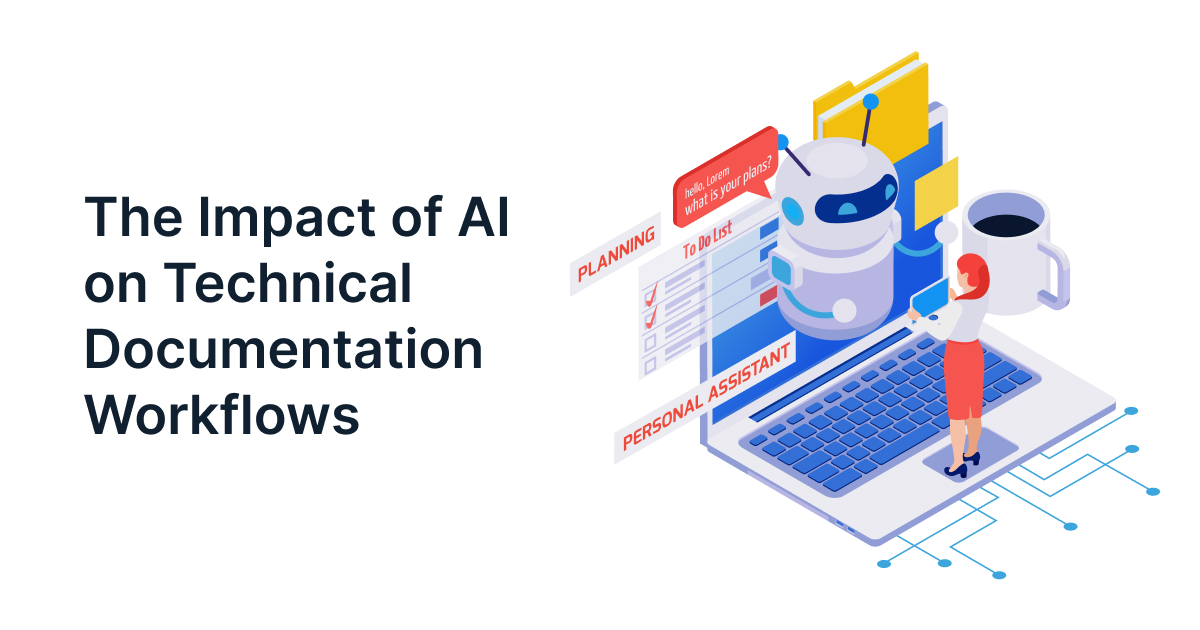
AI technical documentation uses artificial intelligence. Examples include natural language processing, machine learning, and automated data synchronization. This helps to create, update, organize, and deliver complex technical content. Rather than relying on purely manual processes, modern engineering teams leverage AI. AI helps in transforming raw product data into structured manuals, service guides, and operational procedures. This evolution accelerates publishing cycles, improves content reuse, and reduces human error.
However, artificial intelligence does not eliminate the need for human oversight. Yes, it’s true that AI automates repetitive tasks like drafting, tagging, and formatting. At the same time, subject-matter experts remain essential for verifying engineering context, safety compliance, and physical accuracy.
In this blog, we’ll learn how AI is changing the technical documentation process entirely and for good.

Modern technical authoring begins long before a writer opens a text editor. Complex product designs generate immense amounts of structured and unstructured data. The data includes CAD files, bill of materials (BOM), engineering change orders (ECOs), and software log files. AI technical documentation acts as the bridge between raw engineering data and published user documentation.
Engineering Change → System Data (CAD/PLM) → AI Analysis → Affected Content Identified → Writer Review → SME Approval → Publication
Systems running AI technical documentation models automatically draft baseline instructions, user guides, and component descriptions. They do so by ingesting structured inputs from product development tools. By leveraging AI technical writing assistants, authors skip the blank-page stage. They immediately move into refining content, ensuring that technical details align with operational reality.
Product families often share identical assemblies, maintenance routines, or compliance warnings. AI documentation tools analyze content repositories to identify duplicate or similar blocks of text, recommending modular content structures. This intelligent reuse prevents authors from recreating existing documentation. It also guarantees that safety advisories remain identical across all publications.
When an engineer changes a component specification, AI technical documentation platforms flag affected documents. They identify every downstream document requiring updates. Instead of manually searching through hundreds of pages, writers receive targeted prompts. These prompts show exactly which maintenance steps, parts lists, or troubleshooting charts require revision.
Deploying products globally requires precise localized content. AI documentation pipelines leverage domain-trained neural machine translation engines. This instantly translates technical manuals into dozens of languages. These systems preserve specialized terminology and formatting rules, significantly shortening global release cycles.
Integrating AI in technical writing aligns the entire documentation pipeline, replacing disconnected desktop publishing with an automated, data-driven workflow.
| Lifecycle Stage | Traditional Documentation Workflow | AI-Enabled Documentation Workflow |
| Initial Authoring | Manual drafting from engineering specs and raw notes. | Automated first-draft generation powered by AI technical writing. |
| Content Reuse | Manual copy-pasting; risk of inconsistent variations. | Automated modular block identification using AI documentation systems. |
| Quality Review | Line-by-line manual proofreading for style and grammar. | Real-time automated checks via AI documentation tools. |
| Engineering Updates | Manual tracking of ECOs; high risk of outdated manuals. | Automated flags and synchronization driven by AI technical documentation. |
| Translation | Lengthy, costly third-party vendor localization cycles. | Instant, domain-specific machine translation via AI in technical writing. |
Using AI documentation tools reduces manual formatting, index creation, and cross-referencing. Technical writers can prompt specialized systems to restructure unstructured engineering notes. These notes are converted into standardized Simplified Technical English (STE) or clear step-by-step procedures.
In large-scale operations, maintaining a unified voice and strict adherence to industry standards is challenging. AI in technical writing platforms continuously audit drafts against style guides, flagging passive voice, overly complex syntax, and inconsistent phrasing. Deploying specialized AI documentation tools ensures that every manual published meets rigorous quality standards before entering the final review stage.
Organizations adopt AI documentation tools to automate data processing, align authoring, and manage complex publishing operations. This is applicable across multi-tiered engineering environments.
Core Capabilities of AI Documentation Software
While AI documentation tools excel at pattern recognition, processing speed, and data organization, they operate without true physical understanding. Organizations must maintain clear boundaries regarding what AI documentation tools should and should not do independently.
AI vs. Human Responsibilities
What Are the Benefits of AI in Technical Writing?
Adopting AI in technical writing addresses core operational challenges that slow down product launches and increase support overhead.
To maximize value, AI technical documentation platforms must connect directly to core enterprise architecture. Isolated documentation silos lead to drift, where published manuals no longer reflect the actual physical product.
[PLM System] (Design & Engineering Changes)
│
▼
[AI Analysis Engine] (Detects Affected Topics & Translates Data)
│
▼
[MES & ERP Platforms] (Validates Manufacturing & Parts Data)
│
▼
[AI Technical Writing Portal] (Drafts Updates & Alerts Technical Writers)
This connected approach turns static books into dynamic technical assets that evolve throughout the product lifecycle.
Despite its rapid advancement, relying entirely on automated systems presents distinct operational and safety risks. Understanding these limitations allows organizations to implement effective risk-mitigation strategies.
Key Challenges in Automated Technical Authoring
To address these challenges, leading engineering firms adopt a hybrid human-in-the-loop workflow. In this framework, AI technical writing systems handle data processing and initial drafting. At the same time, human technical writers and SMEs retain sole authority over final technical accuracy and compliance approval.
The evolution of AI technical documentation is shifting the medium from static PDF documents toward dynamic, intelligent knowledge environments.
Industry Adoption Metrics
The integration of artificial intelligence into technical communications represents a fundamental shift in how engineering organizations manage knowledge. By leveraging AI technical documentation strategies, businesses can automate repetitive tasks. They can maintain tight alignment with PLM and ERP systems and deliver accurate content to global markets faster than ever before.
However, technology alone is not a complete solution. Realizing the true value of modern AI documentation tools requires balancing automated efficiency with human expertise. Hence, we at Katalyst Engineering help organizations to pair intelligent authoring tools with rigorous SME oversight. Our team helps businesses maintain higher quality standards, reduce operational risk, and gain a decisive competitive advantage.

1. What is AI technical documentation?
AI technical documentation refers to the use of artificial intelligence, machine learning, and natural language processing. This process helps to automate and enhance the authoring, management, translation, and distribution of technical manuals, user guides, and engineering documentation.
2. How is AI used in technical writing?
AI in technical writing is used to generate first drafts from raw data, check content for style and terminology compliance, and organize content blocks for reuse. It is also used to translate manuals into multiple languages, and track engineering changes across product documentation.
3. What are AI documentation tools?
AI documentation tools are software applications designed to assist authors and documentation teams. They leverage natural language processing and integration with engineering systems. This is done to automate metadata tagging, perform quality assurance, assist with drafting, and maintain consistency across large document suites.
4. Can AI replace technical writers?
No, AI is not replacing technical writers. AI technical writing applications handle repetitive drafting, formatting, and proofreading tasks. Human writers are essential for validating technical accuracy, ensuring safety compliance, conducting SME interviews, and designing clear user experiences.
5. How does AI improve technical documentation accuracy?
AI documentation platforms improve accuracy by reducing manual data entry, enforcing uniform terminology, checking drafts against enterprise style guides, and automatically syncing content updates with PLM and ERP engineering databases.
6. What are the main challenges of using AI for technical documentation?
The primary challenges include managing the risk of AI hallucinations, ensuring data security, and IP protection. The challenges also include maintaining high-quality source data in engineering tools and overcoming the lack of real-world physical context in fully automated drafts.

Senior Vice President, Katalyst Engineering
Bhavik Shah is the Vice President of Global Engineering and Manufacturing at Katalyst Engineering, with over 22 years of experience in the engineering industry. He specializes in product development, R&D, and engineering delivery operations, driving innovative, design-led solutions across automotive, industrial, and off-highway sectors. Bhavik plays a key role in strengthening engineering strategies, building global partnerships, and delivering high-performance outcomes for clients.