
At Katalyst Engineering Services, we continually strive to drive innovation by deftly utilizing these resources, changing the issues encountered by various industries and fields with potential solutions.
At Katalyst Engineering Services, we continually strive to drive innovation by deftly utilizing these resources, changing the issues encountered by various industries and fields with potential solutions.

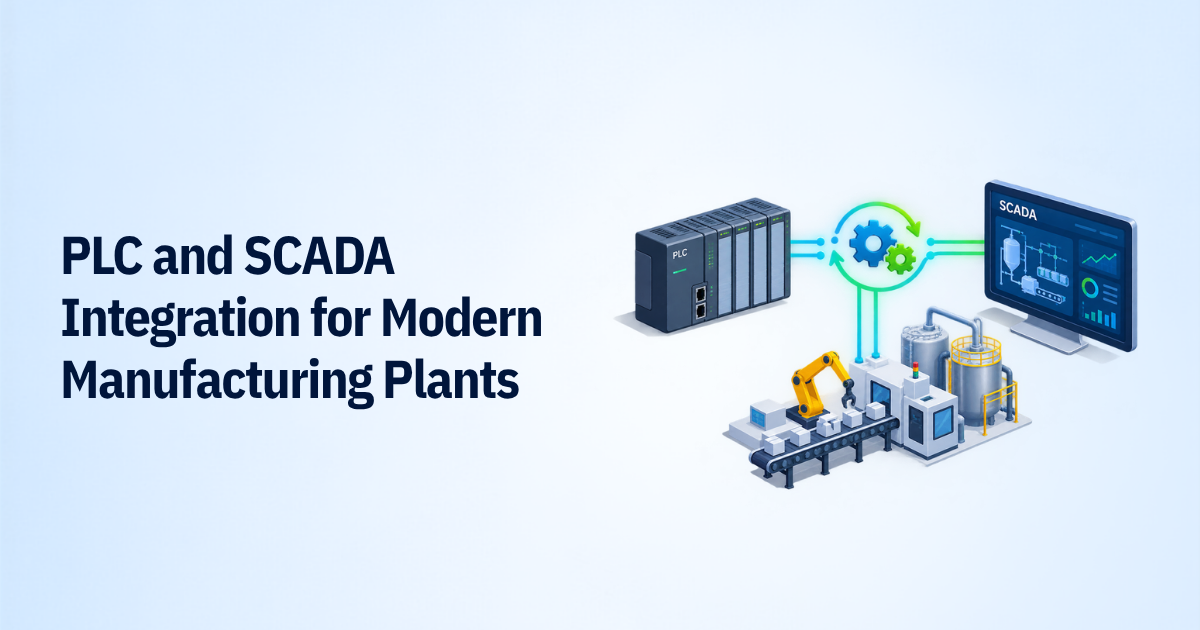
Modern manufacturing plants depend on two systems working together: PLCs that control machines in real time and SCADA systems that give teams visibility across the plant. When PLC and SCADA integration is designed well, operators can see what is happening, respond faster to faults, and make better production decisions without interfering with machine-level control.
PLC and SCADA integration connects machine-level controllers (PLCs) with supervisory monitoring systems (SCADA) so manufacturers can control equipment, monitor operations, manage alarms, analyze performance, and access real-time production data from across the plant.
This guide explains how PLC and SCADA work together, what a practical integration architecture looks like, and how manufacturers can avoid the common problems that make automation projects harder than they need to be. It is written for plant managers, manufacturing engineers, controls teams, and operations leaders to evaluate manufacturing automation systems or planning an industrial automation integration.
Katalyst Engineering supports manufacturers with end-to-end manufacturing engineering services, including process design, control-system planning, documentation, and production optimization.

PLC and SCADA integration is the process of connecting programmable logic controllers with supervisory control and data acquisition software so that machine data, alarms, and control commands can move safely between the plant floor and operators.
A PLC, or programmable logic controller, is the device that runs the actual machine logic. It reads sensors, controls motors, valves, conveyors, and actuators, and executes repeatable control actions in milliseconds. Industrial PLC programming defines how the equipment behaves during startup, normal operation, faults, and shutdown.
SCADA sits above the PLC layer. It does not usually replace the PLC’s control logic. Instead, it gathers information from multiple PLCs, presents it through dashboards and alarms, stores historical data, and allows authorized users to monitor or adjust selected parameters.
In simple terms:
| System | Primary role | Typical example |
| PLC | Real-time machine control | Starts a conveyor, stops a motor on fault, controls a filling sequence |
| SCADA | Plant-wide supervision and visibility | Shows line status, trends, alarms, production counts, and historical performance |
| Integration layer | Secure data exchange | OPC UA server, gateway, industrial network, or middleware |
The value comes from the connection. A PLC can control a machine without SCADA, and SCADA can display data without directly controlling equipment. But together, they create a connected manufacturing environment where operators understand not only whether a machine is running, but why performance is changing.
PLC and SCADA are different but complementary systems. A PLC controls a specific machine or process in real time, while SCADA supervises multiple PLCs and gives operators a plant-wide view of performance, alarms, and historical data.
| Aspect | PLC | SCADA |
| Main purpose | Real-time machine and process control | Supervision, monitoring, and data visualization |
| Level of operation | Machine or cell level | Line, plant, or multi-site level |
| Response time | Milliseconds; executes control logic continuously | Near real time; focuses on monitoring and reporting |
| Typical actions | Controls motors, valves, sensors, conveyors, and actuators | Displays dashboards, trends, alarms, and reports |
| Data role | Generates operational data | Collects, stores, analyzes, and presents data |
| Control scope | Local and deterministic | Supervisory and cross-system |
| Example | Stops a conveyor when a sensor detects a fault | Alerts maintenance, records downtime, and shows line performance |
A PLC is built for speed and reliability at the equipment level. SCADA is built for visibility and coordination across equipment. In a modern plant, they work best together: the PLC makes fast control decisions, while SCADA helps people understand what is happening across the operation.
PLC and SCADA systems work together through a defined communication path: the PLC collects field data and executes control logic, while SCADA requests or receives selected data points, displays them, raises alarms, and records history.
A typical flow looks like this:
That last point matters. SCADA should improve visibility, not become a single point of failure for machine control. If the network or SCADA server goes down, the PLC should continue operating safely according to its programmed logic.
PLC and SCADA integration is important because it turns isolated machine data into usable operational information. Instead of relying on manual logs, shift reports, or local HMI screens, teams can monitor performance across lines, cells, and plants from one system.
The practical benefits include:
This is also where integration connects with broader manufacturing improvement. AI can only create value when it receives reliable operational data; our article on AI in manufacturing engineering explains how manufacturers are applying AI to practical use cases such as quality, maintenance, and process optimization.
Industry stat
Research on IoT-enabled PLC-SCADA architectures found a 12.2% reduction in average energy consumption, a 9% improvement in process-time efficiency, and 97.3% system uptime in the studied application. The result highlights why integration should be measured against energy, throughput, and availability; not just dashboard adoption.
A strong PLC and SCADA integration should include more than a communication cable and a few dashboard screens. It should define what data is collected, how it is named, who can act on it, and how the system behaves during a fault.
At minimum, plan for:
A common mistake is treating SCADA as a reporting tool only. The better approach is to design it as an operational layer: the place where people detect issues, understand causes, and take timely action.
The most common protocols for PLC and SCADA integration are Modbus TCP/IP, Ethernet/IP, Profinet, and OPC UA. The right choice depends on the PLC brand, network design, data volume, security needs, and whether the plant uses equipment from multiple vendors.
| Protocol | Best suited for | Key consideration |
| Modbus TCP/IP | Simple data exchange and legacy equipment | Easy to implement but limited in data modeling and security |
| Ethernet/IP | Allen-Bradley and Rockwell environments | Strong fit within compatible control ecosystems |
| Profinet | Siemens and many European automation environments | Supports deterministic industrial communication |
| OPC UA | Multi-vendor, secure, scalable integration | Provides structured data models and built-in security features |
OPC UA has become especially useful for modern SCADA system integration because it creates a standardized, secure way to move data between PLCs, SCADA platforms, and higher-level business systems. ABB describes OPC UA as a secure and scalable method for data transfer from field devices and PLCs through SCADA and up to cloud systems.
For a plant with mixed equipment, a vendor-neutral integration layer can reduce future complexity. Rather than building a separate connection for every machine, teams can expose data through a consistent interface and make the system easier to maintain.
To integrate PLC and SCADA in an existing plant, start with a data and control assessment, define the integration architecture, map PLC tags, configure secure communication, build operator screens and alarms, and validate the system under real production conditions.
A practical sequence looks like this:
The goal is not to connect every possible signal. It is to connect the signals that help people run the plant better.
The data that should move between PLC and SCADA includes machine status, process values, alarms, production counts, fault codes, cycle times, energy data, and selected operator setpoints. Control-critical and safety-related logic should normally remain within the PLC.
A useful rule is:
This division protects the reliability of the PLC control system design while still giving supervisors the visibility they need. It also prevents SCADA screens from being overloaded with low-value data.
PLC and SCADA integration reduce downtime by making abnormal conditions visible sooner and giving maintenance teams better evidence for root-cause analysis. Instead of waiting for a line to stop or a manual inspection, teams can monitor trends, alarms, and machine states continuously.
For example, if a packaging line begins showing rising motor temperature, intermittent sensor faults, or longer cycle times, SCADA can flag the pattern before the machine fails. Maintenance can inspect the equipment during a planned window rather than after an unplanned stop.
The benefit becomes larger when integration is paired with disciplined maintenance planning. External engineering support can help connect plant-floor data to practical improvements; our guide on external engineering services and manufacturing efficiency explains how engineering teams turn operational constraints into measurable production gains.
Did you know?
NIST’s guidance for operational technology security specifically addresses systems including PLCs and SCADA, emphasizing that industrial environments have unique reliability, performance, and safety requirements that standard IT security controls cannot simply be copied onto.
Yes, PLC and SCADA integration can be secure, but only when cybersecurity is designed into the architecture from the beginning. Because these systems control physical equipment, a security incident can affect production, safety, and product quality; not just data.
Key safeguards include:
The most common PLC and SCADA integration mistakes are unclear data ownership, inconsistent tag naming, excessive alarms, weak network segmentation, and testing only in ideal conditions.
Other frequent issues include:
Most of these problems are preventable through better upfront engineering. A clear integration standard saves time during commissioning and makes the system easier for future teams to support.
At Katalyst Engineering, PLC and SCADA integration is treated as an engineering problem first and a software problem second. The starting point is understanding the production process, equipment constraints, operator workflow, and the decisions the plant needs to make faster.
Our teams help manufacturers define practical integration requirements, improve PLC control system design, standardize data structures, and build SCADA views that support real operational decisions. This approach fits within broader advanced engineering solutions for manufacturers that need to modernize without disrupting production.
The focus is not on adding technology for its own sake. It is on creating manufacturing automation systems that are reliable, understandable, secure, and useful to the people who run them every day. 
PLC and SCADA integration are one of the most practical ways for manufacturers to improve visibility, reduce unplanned downtime, and build a foundation for smarter operations. The best projects do not begin with software selection; they begin with a clear understanding of the production process, the data that matters, and the decisions operators need to make.
If your plant is dealing with disconnected equipment, limited visibility, recurring downtime, or unclear automation data, a structured integration assessment is a sensible next step. Katalyst Engineering can help you evaluate your current systems and plan an integration approach that supports both immediate operational needs and long-term growth. Contact our team to discuss your plant’s automation and integration requirements.
1. What is the difference between PLC and SCADA?
PLC controls equipment in real time by executing programmed logic. SCADA monitors and supervises multiple systems by collecting data, displaying dashboards, managing alarms, and storing historical information. PLCs act locally; SCADA provides a wider operational view.
2. Can SCADA control a PLC?
Yes, SCADA can send approved commands to a PLC, such as changing a setpoint or selecting an operating mode. However, safety logic and critical machine control should remain in the PLC, so equipment continues to operate safely if SCADA is unavailable.
3. Which protocol is best for PLC and SCADA integration?
There is no single best protocol. Modbus TCP/IP is simple and common; Ethernet/IP and Profinet are often brand- or ecosystem-specific, and OPC UA is widely used for secure, scalable, multi-vendor integration. The best choice depends on existing equipment and plant requirements.
4. How long does PLC and SCADA integration take?
A small single-line integration may take a few weeks, while a multi-line or multi-site project can take several months. Timeline depends on the number of PLCs, network readiness, data complexity, legacy equipment, testing needs, and production shutdown windows.
5. Can older PLCs be integrated with modern SCADA?
Yes. Older PLCs can often be integrated using protocol converters, gateways, OPC UA servers, or updated communication modules. The right approach depends on the PLC model, available ports, network infrastructure, and the type of data the plant needs to collect.
6. Does PLC and SCADA integration improve maintenance?
Yes. It gives maintenance teams access to fault history, machine trends, alarm patterns, and operating data. This makes it easier to identify recurring issues, plan inspections, and move from reactive maintenance toward condition-based or predictive maintenance.
7. Is PLC and SCADA integration suitable for small manufacturers?
Yes. Small manufacturers can start with one production line, a limited set of KPIs, and a scalable architecture. The key is to avoid overcomplicating the first phase and to build a data structure that can expand as the plant grows.

Senior Vice President, Katalyst Engineering
Bhavik Shah is the Vice President of Global Engineering and Manufacturing at Katalyst Engineering, with over 22 years of experience in the engineering industry. He specializes in product development, R&D, and engineering delivery operations, driving innovative, design-led solutions across automotive, industrial, and off-highway sectors. Bhavik plays a key role in strengthening engineering strategies, building global partnerships, and delivering high-performance outcomes for clients.