At Katalyst Engineering Services, we continually strive to drive innovation by deftly utilizing these resources, changing the issues encountered by various industries and fields with potential solutions.
At Katalyst Engineering Services, we continually strive to drive innovation by deftly utilizing these resources, changing the issues encountered by various industries and fields with potential solutions.

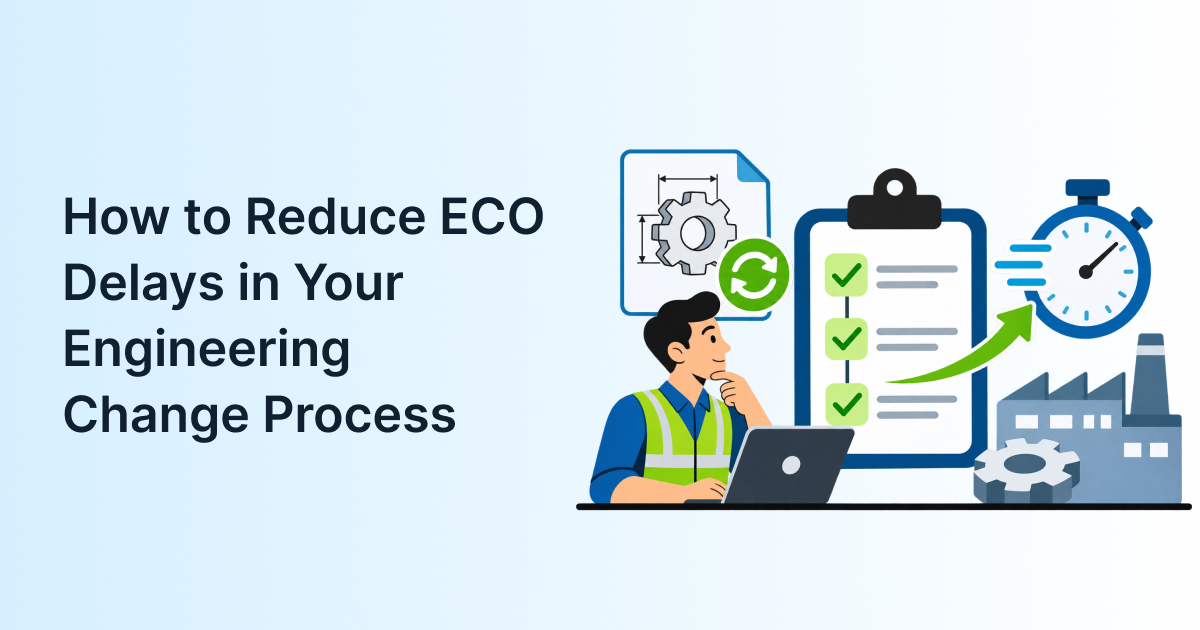
A supplier flags that a bracket can’t hold tolerance. The fix is a 0.5 mm change to one hole. Three weeks later, the drawing is still waiting on a signature, the old revision is still being machined, and purchasing has just reordered 2,000 of the wrong part. Most ECO delays look like this: the engineering takes an afternoon, and the waiting takes the rest.
The engineering change process exists to keep changes controlled and traceable. When it slows down, the controls are rarely the problem. Every change gets the same heavy route, requests arrive incomplete, and the shop floor hears last. Good manufacturing engineering support treats the handoff from approved change to production as part of the change itself. This guide covers where ECOs stall, a simple way to triage changes by risk & the mistakes that keep manufacturing change orders stuck.
The engineering change process is the controlled path a product change follows from idea to production. Someone requests a change, a team assesses its impact, an authority approves it, and the people affected are told to implement it. It keeps drawings and BOMs in sync and stops the shop from building an outdated revision.
It runs through the whole product development process, from prototype to production and long after launch. Most companies manage it with three documents. The names vary by company and PLM tool, but the roles stay the same.
When people compare ECR vs ECO vs ECN, they’re really asking who owns which step. The difference between ECO and ECR comes down to authority: an ECR asks for a change, an ECO authorizes it, and an ECN tells everyone it has happened. So, which comes first? Always the request.
| Document | What it does | Who raises it | What it contains |
| ECR (engineering change request) | Proposes a change and explains why | Anyone: engineering, quality, production, a supplier or a customer | Problem, evidence, affected parts, suggested fix, urgency |
| ECO (engineering change order) | Authorizes the change and defines exactly what changes | Engineering, after review | Drawings and BOM lines, new revisions, effectivity, inventory disposition, approvals |
| ECN (engineering change notice) | Tells the people who must act what changed | Engineering or document control | What changed, from which lot or date, what each team must do |
Some companies merge the ECO and ECN into one record. That works, if the people who build, buy and inspect the part receive it.
Here’s an illustrative example. A plant machining pump housings sees field returns from a leaking seal at one port. An ECR proposes deepening the O-ring groove by 0.3 mm. The ECO moves the housing drawing from Rev C to Rev D, flags the CNC program for update, adds the new seal to the BOM, sets effectivity from the next lot, and decides what happens to 400 Rev C housings in stock. The ECN then goes to machining, quality, purchasing and service.
Notice how much of that ECO sits outside the drawing. That’s where the delays hide.
ECOs get delayed mainly while they wait: in an inbox, for a board meeting, for missing information, or for the shop floor to get ready. The technical work inside most changes is small. The delay comes from routing every change the same way and discovering downstream impact late, often after the order is already approved.
Did you know?
“According to research by SolidWorks, 56% of manufacturers surveyed cite late-stage design changes as a reason for missed launch dates.”
The usual causes are familiar to anyone who has chased a signature:
Many late changes are manufacturability problems that a DFM review done before release would have caught. Those are the cheapest ECOs of all: the ones you never have to raise.
Match the review effort to the risk of each change. Insist on complete information at submission, give every review step a time limit, and confirm production readiness before release rather than after. Together, these cut waiting time without removing the approvals that protect quality and traceability.
If you’re wondering whether every change needs a full board review, the short answer is no. Sending everything down one path feels safe, but it buries the risky changes under the trivial ones. A three-lane model suits most product engineering teams:
| Lane | Typical changes | Who approves | Starting target |
| Fast | Documentation fixes with no form, fit or function impact | Design owner and document control | 1–2 working days |
| Standard | Changes within one part or assembly, no supplier, cost or compliance impact | Engineering lead and manufacturing engineer | About 5 working days |
| Full | Anything touching form, fit, function, safety, certification, suppliers, cost or fielded product | Full change control board | Set per change, reviewed weekly |
The targets are starting points to tune against your own data, not industry benchmarks. What makes the model work is that the lane is set by fixed questions at submission, not by how urgent the requester feels. Does it change form, fit or function? Does it touch a supplier, a certified part or stock on hand? Any yes moves it up a lane.
Half-filled requests create the longest loops. Define the minimum an ECR need before review: affected part numbers and revisions, reason and evidence, proposed fix, stock and WIP quantities, and open orders. Make those fields mandatory and return incomplete requests within a day.
Weekly meetings suit full-lane changes. For the rest, route reviews in parallel with a time limit, such as 48 hours per reviewer, and escalate when it expires. Quality, purchasing and manufacturing can then assess impact at the same time instead of one after another.
An ECO isn’t finished when it’s signed. It’s finished when the plant can build the new revision.
Our view at Katalyst Engineering is that the fix starts earlier than most teams think: bring a manufacturing engineer into impact assessment, not just sign-off. Before release, confirm four things. Tooling and fixtures are updated or ordered.
CNC and robot programs are revised and proven. Work instructions and inspection plans match the new revision. Effectivity and inventory disposition are clear. A change that clears these checks reaches the floor once, instead of coming back as a second ECO.

The most common mistakes are bundling unrelated fixes into one ECO, approving changes without an inventory disposition, using redlines as the release, and leaving manufacturing engineering out until after sign-off. Each one adds the waiting or rework that the change process was supposed to prevent in the first place.
Bundling to save paperwork – Grouping five fixes into one ECO feels efficient until one needs supplier approval and the other four wait with it. Bundle only changes that must go in together.
Approving without a disposition – If nobody decides what happens to existing stock and WIP, purchasing and production make their own calls. That’s how old revisions get built after the change.
Using redlines as the release – Marked-up prints on the floor feel quick but break traceability. Formally releasing the revised drawing belongs inside the ECO, not in a follow-up task.
Keeping manufacturing at arm’s length – When product design and development services partners, toolmakers or programmers handle part of the work, they need a place in the change route. It’s worth seeing how OEMs typically structure manufacturing engineering support across the lifecycle, so those handoffs are planned rather than improvised.
Measure ECO cycle time per change lane, from a complete submission to production effectivity, and split it into stages: waiting for review, in review, waiting for release and implementation. A single average across all changes hides the problem, because a few complex changes skew it and fast ones mask the slow.
Stage timestamps show where the queue sits. If time piles up waiting for review, add reviewers or tighten limits. If it piles up after approval, the problem is production readiness, and stronger engineering project management on the manufacturing side will help more than a faster board. Also track how many ECOs exist only to correct an earlier ECO. That number tells you whether speed is costing accuracy.

A slow engineering change process is usually a routing problem dressed up as a control problem. Keep the controls, send each change only through the checks it needs, and treat the plant’s readiness as part of the change rather than the next team’s job.
Simple changes then move in days, and complex ones get the attention they deserve. If you’d like a second pair of eyes on where your changes stall between approval and production, we’re glad to talk it through with your team.
1. How long should an engineering change order take?
There’s no single right number, because cycle time depends on the type of change. A documentation fix should clear in a day or two, while a change affecting suppliers, certification or fielded product can reasonably take weeks. Set targets per change class from your own history, then track whether you hit them.
2. Who should sit on a change control board?
A typical change control board includes the design owner, manufacturing engineering, quality, purchasing or supply chain, and document control. Bring in service, regulatory or finance only when a change affects them. Keep the core group small, because a board that grows too large becomes the bottleneck it was meant to prevent.
3. Can an engineering change be expedited for urgent issues?
Yes. Most teams keep an emergency or deviation route for safety issues, line-down situations and customer-critical problems. A temporary deviation lets production continue under defined conditions while the formal ECO catches up. Put an expiry date on every deviation and close it with a full ECO, so the quick fix never becomes an undocumented permanent one.
4. What is effectivity in an engineering change order?
Effectivity defines when a change takes effect: from a date, a production lot, a serial number, or once existing stock runs out. It tells purchasing and production which orders use the new revision, and which keep the old one. Vague effectivity is a common reason outdated parts keep getting built after approval.
5. Do small manufacturers need PLM software to manage engineering changes?
Not always. A small team can run a disciplined change process with a controlled form, one shared change register and clear revision rules. PLM or PDM software earns its cost when change volume grows, several sites or suppliers are involved, or audits demand a complete digital trail. Process design matters more than the tool.
6. What usually triggers an engineering change request?
Common triggers include quality problems and field failures, manufacturability issues, supplier changes or part obsolescence, cost-reduction ideas, customer requests and new regulations. Anyone who spots the issue can raise an ECR. What matters is that it captures the problem and the evidence clearly, so reviewers can judge it without chasing the requester.

Senior Vice President, Katalyst Engineering
Bhavik Shah is the Vice President of Global Engineering and Manufacturing at Katalyst Engineering, with over 22 years of experience in the engineering industry. He specializes in product development, R&D, and engineering delivery operations, driving innovative, design-led solutions across automotive, industrial, and off-highway sectors. Bhavik plays a key role in strengthening engineering strategies, building global partnerships, and delivering high-performance outcomes for clients.