At Katalyst Engineering Services, we continually strive to drive innovation by deftly utilizing these resources, changing the issues encountered by various industries and fields with potential solutions.
At Katalyst Engineering Services, we continually strive to drive innovation by deftly utilizing these resources, changing the issues encountered by various industries and fields with potential solutions.

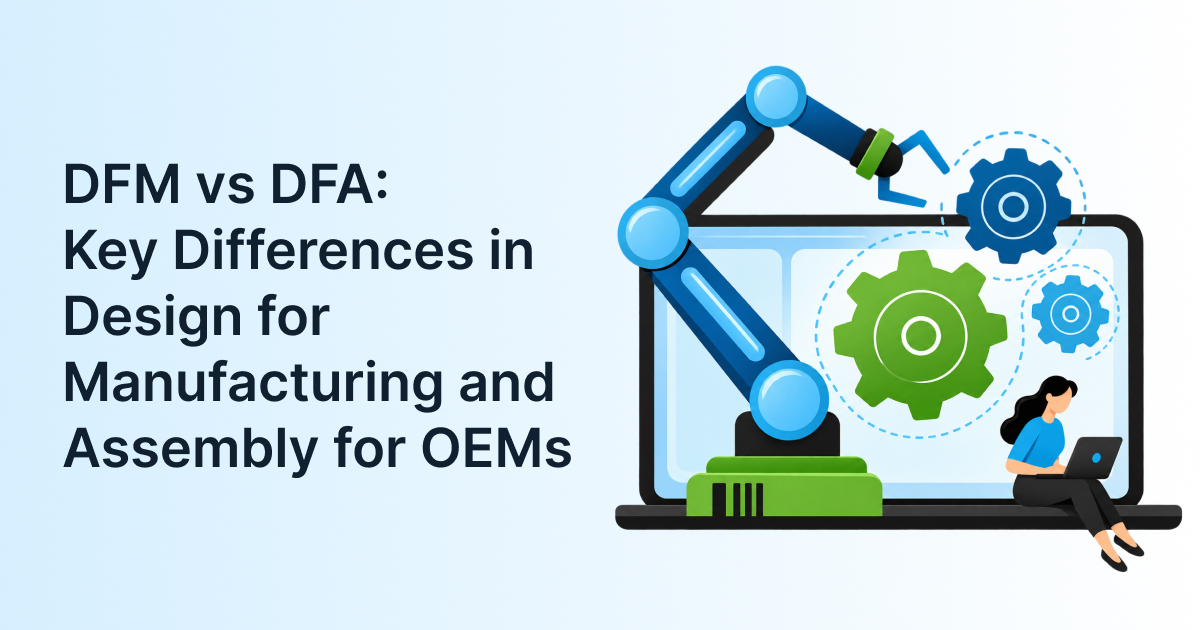
A bracket that machines perfectly can still cost you money if an operator needs four screws, two hands and a flashlight to install it. That gap is why two disciplines exist. Design for manufacturability (DFM) asks whether each part can be made cheaply and consistently. Design for assembly (DFA) asks whether those parts go together quickly and without mistakes.
Together they form design for manufacturing and assembly (DFMA), and OEMs that treat it as one checkbox usually improve one side at the expense of the other. Good manufacturing engineering support keeps both questions on the table from the first concept sketch.
Design for manufacturability looks at one part at a time and asks how to produce it with the least cost, scrap and tooling. Design for assembly looks at the whole product and asks how to build it with the fewest parts, steps and errors. In short, DFM lives at the machine or mold, and DFA lives at the assembly station.
| Aspect | Design for manufacturability (DFM) | Design for assembly (DFA) |
| Unit of analysis | A single part | The full assembly or subassembly |
| Core question | Can we make this part cheaply and consistently? | Can we build this product quickly and correctly? |
| Main levers | Material, process, tolerances, wall thickness, draft, standard features | Part count, fasteners, orientation, self-locating features, error-proofing |
| Typical metrics | Cycle time, scrap rate, tooling cost, yield | Assembly time, operator steps, rework, first-pass yield |
For the part-level rules in more depth, our piece on the core principles behind DFM covers materials, tolerances and process selection.
DFMA is less a third method than an agreed order of work. The classic approach runs DFA first to cut part count, then applies DFM to the parts that survive. There’s no point perfecting tooling for a bracket the next review will eliminate.
DFMA as a formal method traces back to research that Geoffrey Boothroyd and his colleagues began at the University of Massachusetts in the early 1970s.
So, can a team do DFM and DFA at the same time? Yes, and on most real programs it must.
OEMs need both because a saving on one side can create a cost on the other. Merging three stamped parts into one casting is a clear DFA win, but that casting may need a new mold, tighter tolerances and longer supplier lead time. Reviewing both together stops one team’s improvement from becoming another team’s problem.
Take an example of an OEM building a sheet-metal control enclosure. Swapping separate hinge hardware for formed tabs removes six fasteners from assembly. But the tabs need a tighter bend tolerance, and the supplier’s older press brake may not hold it without an extra setup.
From where we sit at Katalyst, these conflicts rarely show up in the CAD model. They show up in the supplier quote and the first pilot build, which is why we push for both inputs before design freeze, not after.
Start with whichever side holds more of your unit cost and quality pain. If part fabrication, tooling and scrap dominate, lead with DFM. If assembly labor, rework and installation errors dominate, lead with DFA. A quick look at your “should-cost model” and “line data” usually settles it.
If you’re wondering where to begin with a product already in production, the short answer is following the money on your current unit cost, using the signals below.
| Signal to check | Points to DFM first | Points to DFA first |
| Cost breakdown | Fabricated parts and tooling are the larger share | Assembly labor and rework are the larger share |
| BOM shape | A few complex, high-value parts | Many low-value parts, brackets and fasteners |
| Quality data | Scrap and out-of-tolerance parts at the supplier | Rework, missing fasteners or wrong way installs at the station |
| Workforce | Stable, experienced assembly team | Hard-to-fill assembly roles, long operator training |

It works best as a thread through every stage of product design and development, not a gate at the end. DFA shapes the concept and part count, DFM shapes detailed part design, and pilot builds test both against the real line before tooling is released.
Concept – This is where DFA earns the most. For every part, ask: does it move relative to its neighbors, must it be a different material, and must it come apart for service or assembly? If all three answers are no, it’s a candidate to merge.
Detailed design – DFM takes over. Mechanical design engineering choices like tolerances, hole sizes and process get checked against what suppliers’ equipment can hold. Manufacturing process design starts here too: fixtures, assembly sequence and inspection points.
Pilot and production – Time studies and operator feedback show whether the design behaves as reviews assumed. After launch, scrap and rework data feed the next revision, which is where manufacturing process optimization keeps paying off. For the wider picture, see what manufacturing engineering covers across an OEM’s product lifecycle.
The most common mistake is treating both as a final drawing check after design freeze, when changes are slow and costly. Others include consolidating parts too far, over-tolerancing everything, and leaving operators and suppliers out of reviews until problems appear in production.
Is it too late once the design is frozen? Not entirely. Loosening non-critical tolerances or changing fastener types can go into the next engineering change. A structured DFM review process helps rank which changes justify reopening a released design, so effort goes into practical manufacturing solutions rather than paperwork.
Key Takeaways

DFM and DFA answer two different questions, and a product only becomes cheap to build when both answers are good. The OEMs that get the most from design for manufacturing and assembly don’t pick a favorite.
They read their own cost and quality data, decide which question to ask first, and keep both teams involved until release. If you’d like a second set of eyes on where your design’s cost actually sits, start a conversation with our engineering team and we’ll work through it with you.
1. Is DFMA the same as DFM?
No. DFM focuses on making individual parts easier and cheaper to produce through material, process, tolerance and tooling choices. DFMA combines DFM with design for assembly, so it also covers part count, fasteners and how parts come together. Agree on scope before a review starts, since many teams use “DFM” loosely for both.
2. What are the main principles of design for assembly?
Reduce the number of parts, cut separate fasteners, design parts that locate and align themselves, make parts either symmetrical or clearly asymmetrical so they can’t go in the wrong way, and allow assembly from one direction where possible. Each one cuts assembly time and the chance of errors.
3. When should DFM and DFA start in product development?
Both should start at the concept stage. DFA has the most influence early, while part count and architecture are still flexible. DFM gets more detailed once parts are designed and processes chosen. After drawings are released, every change need re-approval, new quotes and sometimes new tooling.
4. Does design for assembly only matter for automated lines?
No. DFA grew out of assembly automation research, but its principles help manual lines just as much. Fewer parts, self-locating features and error-proof orientation cut assembly time, training needs and mistakes for human operators. It also makes later automation easier.
5. How is DFM different for machined, molded and sheet-metal parts?
The goal is the same, but the rules follow the process. Machined parts focus on tool access, standard hole sizes and avoiding needless tight tolerances. Molded parts focus on uniform walls, draft angles and gate placement. Sheet-metal parts focus on bend radii, hole-to-bend distances and flat-pattern efficiency.

Senior Vice President, Katalyst Engineering
Bhavik Shah is the Vice President of Global Engineering and Manufacturing at Katalyst Engineering, with over 22 years of experience in the engineering industry. He specializes in product development, R&D, and engineering delivery operations, driving innovative, design-led solutions across automotive, industrial, and off-highway sectors. Bhavik plays a key role in strengthening engineering strategies, building global partnerships, and delivering high-performance outcomes for clients.