At Katalyst Engineering Services, we continually strive to drive innovation by deftly utilizing these resources, changing the issues encountered by various industries and fields with potential solutions.
At Katalyst Engineering Services, we continually strive to drive innovation by deftly utilizing these resources, changing the issues encountered by various industries and fields with potential solutions.

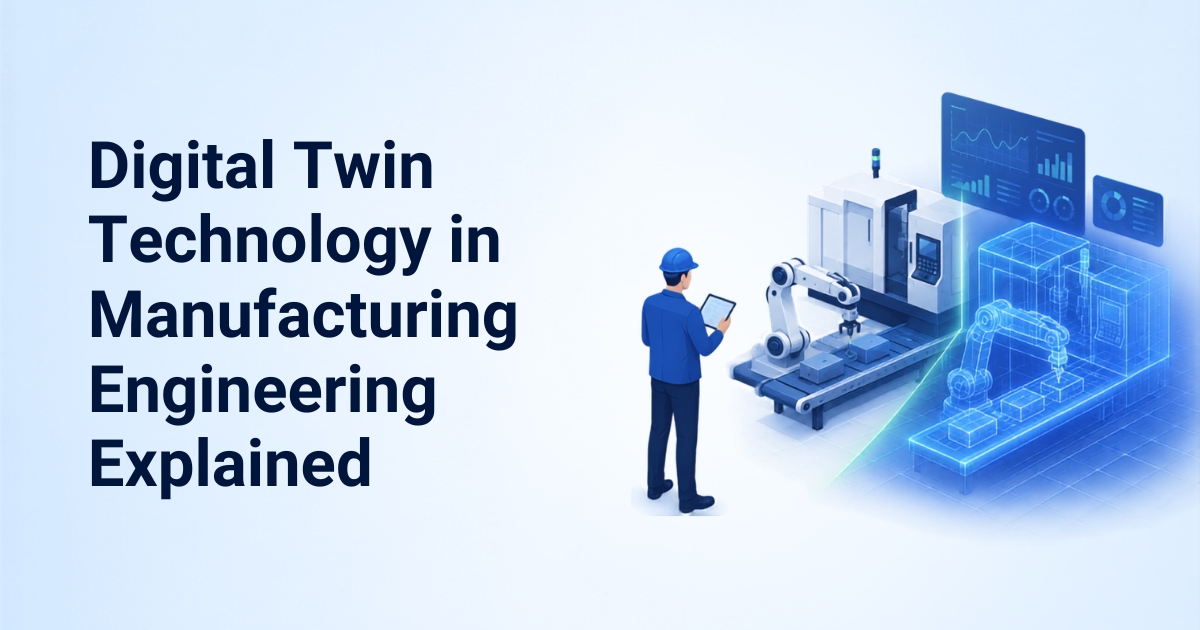
Digital twin technology creates a virtual representation of a physical product, process, or manufacturing system that continuously updates using real-time data. In manufacturing engineering, digital twins help improve design accuracy, optimise operations, predict failures, reduce downtime & support better decision-making throughout the product lifecycle.
As manufacturing becomes increasingly connected and data-driven, organisations are investing in technologies that bridge the gap between the physical and digital worlds. Among these innovations, digital twin technology has emerged as a cornerstone of modern manufacturing engineering. By creating dynamic virtual replicas of machines, production lines, facilities, and products, manufacturers can simulate, monitor, analyse & optimise operations with unprecedented precision.
The growing adoption of digital twins is also accelerating broader digital transformation in engineering, helping organisations make smarter decisions and improve operational efficiency. Combined with advanced engineering solutions, digital twins enable manufacturers to identify problems before they occur, enhance product quality & streamline production processes.
For organisations looking to support complex engineering workflows and documentation associated with digital initiatives, professional technical publication services play an important role in maintaining accurate, accessible & up-to-date technical information.

To understand digital twin technology, you need to view it as a living digital model that mirrors a physical asset using real-time operational data. Unlike static 3D models, digital twins continuously evolve as conditions change in the physical environment.
A digital twin is a virtual representation of a physical object, machine, product, process, factory, or system. Sensors embedded in physical assets collect data and transmit it to digital platforms where the virtual model updates continuously.
The digital twin can then be used to –
In today’s digital twin industry, these capabilities enable manufacturers to move from reactive decision-making to proactive and predictive operations.
To implement digital twin manufacturing, organisations need to combine physical assets, IoT sensors, data analytics, simulation software, and cloud platforms into a connected ecosystem. This creates a feedback loop between the physical and digital environments.
The process generally includes –
Data Collection
Sensors collect information from equipment, machines & production lines, including –
Digital Model Creation
Engineers develop a virtual replica of the physical system using CAD, simulation & modelling tools.
Real-Time Synchronisation
Operational data continuously updates the model to accurately reflect real-world conditions.
Simulation and Analysis
Manufacturers run simulations to test scenarios and identify optimisation opportunities without disrupting production.
Continuous Improvement
Insights generated from the twin help improve design, maintenance planning, and operational efficiency.
This approach supports significant advancements in digital transformation in engineering by enabling data-driven engineering decisions.
To improve manufacturing performance, organisations need visibility into assets, processes & system behaviour. Digital twin technology provides that visibility while enabling predictive and proactive decision-making.
Modern manufacturing faces challenges such as –
Digital twins help address these challenges through –
Enhanced Product Design
Engineers can test and validate designs virtually before physical prototyping begins.
Reduced Downtime
Predictive maintenance capabilities identify potential failures before they occur.
Better Resource Utilisation
Manufacturers can optimise equipment usage, staffing & energy consumption.
Faster Innovation
Virtual testing allows organisations to accelerate product development cycles.
These benefits make digital twins an essential component of advanced engineering solutions used by leading manufacturers.
To maximise value from digital twins, manufacturers typically focus on high-impact applications that improve asset reliability, production efficiency & engineering decision-making.
Predictive Maintenance
One of the most popular digital twin use cases is predicting equipment failure.
By analysing machine behaviour and sensor data, organisations can identify abnormal patterns before breakdowns occur.
Benefits include –
Production Line Optimisation
Digital twins provide visibility into production bottlenecks and inefficiencies.
Manufacturers can test production changes virtually and identify optimal operating conditions before implementing them on the shop floor.
Quality Control
Digital twins help engineers understand how process changes affect product quality.
Manufacturers can quickly detect quality issues and take corrective action.
Product Lifecycle Management
Engineering teams can monitor products from design through operation and maintenance.
This creates valuable feedback for future product development efforts.
Energy Optimisation
Digital twins can identify areas of excessive energy consumption and suggest efficiency improvements.
These digital twin use cases help manufacturers achieve both sustainability and cost-reduction goals.
To achieve measurable operational improvements, manufacturers use digital twins to gain deeper visibility, reduce uncertainty & optimise performance throughout the production lifecycle.
Some of the primary benefits of digital twin in manufacturing include –
Improved Operational Efficiency
Real-time monitoring helps identify inefficiencies and improve overall equipment effectiveness (OEE).
Lower Maintenance Costs
Predictive insights minimise unnecessary maintenance activities while preventing unexpected failures.
Faster Product Development
Engineering teams can validate concepts virtually, reducing the need for multiple physical prototypes.
Better Decision-Making
Digital twins provide engineers and managers with accurate, real-time operational insights.
Enhanced Safety
Virtual simulations help identify risks before changes are implemented in physical facilities.
These advantages demonstrate why digital twin manufacturing continues to gain momentum across industrial sectors.
To understand the expansion of the digital twin industry, it is important to recognise that manufacturing is only one part of a broader industrial transformation.
Industries using digital twins include –
| Industry | Common Applications |
| Manufacturing | Production optimisation, predictive maintenance |
| Aerospace | Aircraft performance monitoring |
| Automotive | Vehicle development and validation |
| Energy & Utilities | Asset monitoring and maintenance |
| Healthcare | Equipment management and simulation |
| Smart Cities | Infrastructure planning and management |
Manufacturing remains one of the most mature sectors adopting digital twin solutions due to its heavy reliance on equipment, processes, and engineering data.
To successfully execute digital transformation in engineering, organisations need technologies that connect data, simulation, analytics, and operational intelligence. Digital twin solutions serve as a central enabler of this transformation.
Digital twins support engineering teams by –
Organisations implementing advanced engineering solutions increasingly integrate digital twins with –
For additional insights into manufacturing digitisation strategies, readers may find value in exploring Katalyst Engineering’s article on AI in Manufacturing Engineering: Practical Applications for Modern Factories.
Similarly, businesses exploring industrial digitalisation initiatives can learn more from the guide on Digital Twins in Industrial Manufacturing, which examines broader industry adoption trends.
To implement digital twins successfully, organisations must address both technical and organisational challenges that can impact adoption and long-term value.
Common challenges include –
Data Integration Issues
Manufacturing systems often contain disconnected legacy technologies that make integration difficult.
High Initial Investment
Developing accurate digital twins requires investment in sensors, software, infrastructure & expertise.
Data Quality Concerns
Poor-quality data can reduce the effectiveness of simulations and predictive analytics.
Skills Gaps
Successful digital twin initiatives require expertise in engineering, analytics & digital technologies.
Despite these challenges, long-term returns often justify the investment.
To stay competitive, manufacturers will increasingly leverage digital twins alongside AI, automation & advanced analytics. Future digital twin ecosystems will become more intelligent, autonomous & scalable.
Emerging trends include –
As these innovations mature, digital twin technology will become a core component of digital transformation in engineering strategies worldwide.

Digital twin technology is transforming manufacturing engineering by providing real-time visibility into products, processes, and assets. From predictive maintenance and process optimisation to product development and lifecycle management, digital twins help organisations make more informed decisions and improve operational performance.
As manufacturers continue investing in advanced engineering solutions, digital twins will play an increasingly important role in driving efficiency, innovation & business resilience.
If your organisation is exploring engineering modernisation, digital transformation initiatives, or digital twin implementation strategies, contact the Katalyst Engineering team to discuss how specialised engineering support can help accelerate your journey.
Key Takeaways
1. What is digital twin technology in manufacturing?
Digital twin technology creates a virtual representation of physical manufacturing assets, processes, or systems. It continuously updates using real-time data, enabling manufacturers to monitor performance, predict issues & optimise operations more effectively.
2. How does digital twin manufacturing improve efficiency?
Digital twin manufacturing improves efficiency by providing real-time visibility into operations, identifying bottlenecks, supporting predictive maintenance & enabling simulation-driven optimisation before changes are implemented on the factory floor.
3. What are the most common digital twin use cases?
Common digital twin use cases include predictive maintenance, production line optimisation, quality assurance, product lifecycle management, energy management & supply chain optimisation across manufacturing environments.
4. What are the major benefits of digital twin in manufacturing?
The benefits of digital twin in manufacturing include reduced downtime, lower maintenance costs, improved product quality, faster product development, better resource utilisation, and enhanced operational decision-making.
5. Which industries use digital twin solutions?
Digital twin solutions are widely used in manufacturing, aerospace, automotive, healthcare, energy, utilities, construction & smart city development to improve operational efficiency and asset management.
6. How do digital twins support digital transformation in engineering?
Digital twins support digital transformation in engineering by connecting physical assets with real-time data, enabling simulation-based decision-making, improving collaboration & helping organisations adopt more intelligent operational practices.
7. Are digital twins and simulations the same thing?
No. Traditional simulations operate using predefined assumptions, while digital twins continuously receive and process real-time data from physical systems, making them dynamic and continuously updated models.
8. What technologies enable digital twin industry growth?
The digital twin industry relies on IoT sensors, cloud computing, artificial intelligence, machine learning, big data analytics, simulation platforms & advanced engineering solutions to deliver accurate digital representations.

Senior Vice President, Katalyst Engineering
Bhavik Shah is the Vice President of Global Engineering and Manufacturing at Katalyst Engineering, with over 22 years of experience in the engineering industry. He specializes in product development, R&D, and engineering delivery operations, driving innovative, design-led solutions across automotive, industrial, and off-highway sectors. Bhavik plays a key role in strengthening engineering strategies, building global partnerships, and delivering high-performance outcomes for clients.