
At Katalyst Engineering Services, we continually strive to drive innovation by deftly utilizing these resources, changing the issues encountered by various industries and fields with potential solutions.
Product costs rarely become a problem on the shop floor overnight. More often, they begin as seemingly reasonable engineering decisions made months earlier. A tighter tolerance here. An additional bracket there. A custom component added to meet a specific requirement.
Individually, these decisions may appear insignificant. Collectively, they can influence manufacturing cost, assembly complexity, production timelines, quality outcomes & ultimately, product profitability for years to come.
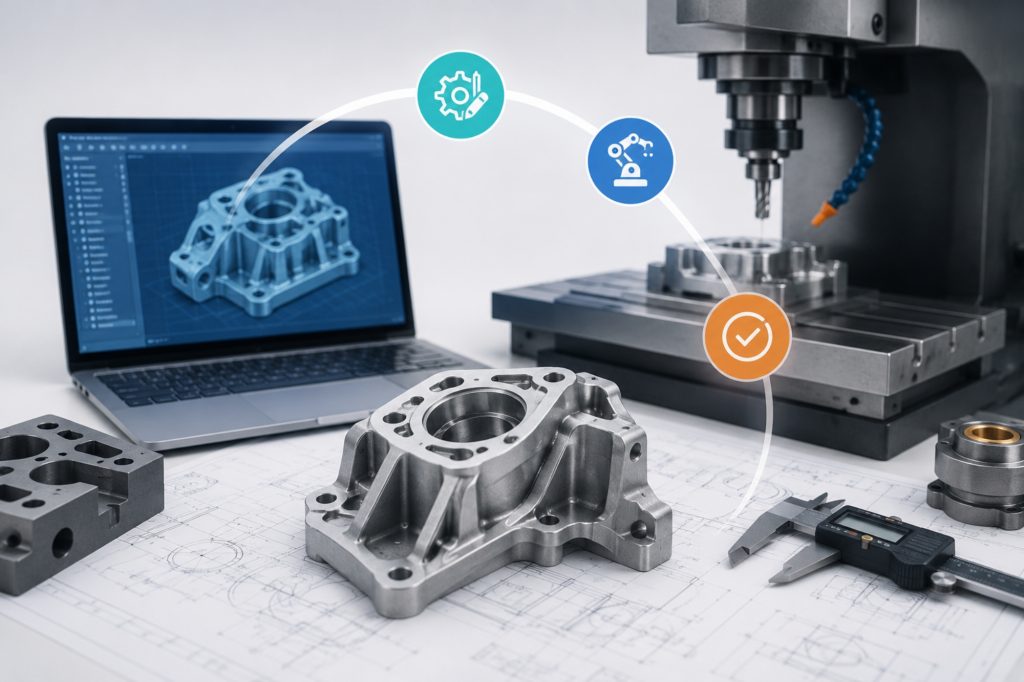
This is why Design for Manufacturability (DFM) has become far more than an engineering best practice. It has evolved into a strategic capability that helps manufacturers bridge the gap between product design and production performance.
Yet many organizations still approach manufacturability too late in the product development cycle.
The result is familiar to engineering leaders, manufacturing managers, and operations teams alike. Products that perform well in testing encounter unexpected challenges during production. Assembly processes take longer than anticipated. Suppliers raise concerns about feasibility. Quality teams identify inspection bottlenecks. Production costs exceed early estimates.
At that point, changes become significantly more expensive. The most successful manufacturers avoid this scenario by asking a different question earlier in development:
“How will this product perform in production, not just in design?”
In our latest white paper, Beyond Cost Reduction: A Manufacturing Leader’s Guide to Design for Manufacturability (DFM), we explore why manufacturability has become one of the most important drivers of long-term manufacturing success and where organizations commonly leave value on the table.
Inside the guide, you’ll discover –
More importantly, the white paper provides a strategic perspective on why reducing costs is no longer simply a manufacturing responsibility. In today’s environment, the ability to connect engineering decisions with downstream production outcomes has become a critical competitive advantage.
Whether you’re developing a new product, evaluating an existing platform, preparing for production scale-up, or looking for opportunities to improve margins without compromising quality, understanding manufacturability earlier in the development process can have a lasting impact on business performance.
The greatest opportunities for cost reduction are often found before production begins. Ready to evaluate how manufacturable your products really are?
Download the full white paper to explore the frameworks, assessment tools, industry insights, and practical recommendations that can help your organization improve production readiness, reduce hidden costs & strengthen long-term manufacturing performance.
Manufacturing organizations today operate in an environment defined by constant pressure. Customers expect more capable products. Supply chains remain volatile. Labor challenges persist. Product complexity continues to increase. At the same time, leadership teams are being asked to achieve faster product launches, higher quality, lower costs & stronger margins.
To meet these challenges, many companies invest heavily in operational excellence initiatives. They implement lean manufacturing programs, automate production lines, optimize procurement strategies & deploy digital technologies across the factory floor.
These initiatives undoubtedly deliver value. However, an important reality is often overlooked. Many manufacturing costs, quality issues & production constraints are embedded into a product long before production begins.
A design decision made during concept development can influence material consumption, tooling requirements, assembly complexity, inspection effort, supplier flexibility & production throughput for years to come.
This is why Design for Manufacturability (DFM) has evolved from a design-review activity into a strategic business discipline. Organizations with mature DFM programs view manufacturability as a core component of product development rather than a manufacturing department responsibility. They recognize that the products easiest to manufacture are often the products that achieve superior quality, faster scaling, stronger margins & greater long-term competitiveness.
This white paper examines –
For engineering leaders, operations managers & manufacturing decision-makers, the opportunity is clear. The greatest manufacturing improvements often begin before manufacturing starts.
The manufacturing environment has changed dramatically over the last decade. Organizations are no longer competing solely on product quality or production capacity. Increasingly, success depends on how efficiently products move from concept to scalable production.
The table below highlights several pressures affecting manufacturers today and how DFM addresses them.
| Manufacturing Challenge | Business Impact | How DFM Helps |
|---|---|---|
| Rising material costs | Margin pressure | Material optimization and part consolidation |
| Skilled labor shortages | Increased assembly costs | Simplified assembly and automation readiness |
| Product complexity growth | Higher quality risk | Design simplification and standardization |
| Supply chain disruptions | Extended lead times | Component and supplier flexibility |
| Faster launch schedules | Increased development risk | Early manufacturability validation |
| Quality expectations | Greater compliance burden | Improved process consistency and repeatability |
While these challenges are often treated as operational problems, many originate from decisions made during engineering and product development.
Most manufacturers can relate to a familiar scenario.
A product progresses successfully through development. The design meets performance specifications. Prototype testing is completed. Customer requirements are satisfied. The product appears ready for production. Then manufacturing teams begin preparing for launch.
Assembly challenges emerge. Suppliers identify manufacturability concerns. Quality teams struggle with inspection requirements. Operations discovers cycle times exceeding expectations. Procurement encounters sourcing constraints.
At this point, organizations often view these as manufacturing issues. In reality, many are design decisions revealing themselves for the first time in a production environment.
One of the most important concepts in DFM is understanding when costs become committed.
| Product Lifecycle Stage | Ability to Influence Cost | Cost of Making Changes |
|---|---|---|
| Concept Development | Very High | Very Low |
| Preliminary Design | High | Low |
| Detailed Design | Moderate | Moderate |
| Prototype Validation | Low | High |
| Production Launch | Very Low | Very High |
| Full Production | Minimal | Extremely High |
The paradox of product development is simple. The earlier a design issue is identified, the less expensive it is to resolve.
Organizations that wait until pilot production to assess manufacturability frequently discover that the cost of change far exceeds the cost of prevention.
One of the most widely accepted principles in product development is that most of a product’s manufacturing cost is determined during design and development, even though only a small percentage of project spending has occurred at that stage.
The implication is significant. Many cost-reduction programs target expenses after they have already been designed into the product. Teams may focus on sourcing strategies, throughput improvements, or labor optimization when the largest opportunity may actually reside in engineering decisions that have remained unquestioned for years.
This does not mean manufacturing excellence is unimportant. Rather, it means manufacturing excellence becomes substantially easier when products are designed with production realities in mind.
A manufacturability gap exists whenever there is a disconnect between product design and production reality.
Engineering teams naturally focus on –
Manufacturing teams focus on –
Supply chain teams focus on –
Each group is pursuing legitimate objectives. Challenges emerge when these objectives are addressed independently.
A product can function exactly as intended while simultaneously introducing excessive manufacturing complexity, long production cycles, quality variability & sourcing challenges.
The organizations that consistently outperform competitors are those that eliminate this gap by integrating manufacturing considerations throughout product development.
Many manufacturing inefficiencies can be traced back to a relatively small number of recurring design decisions.
| Design Characteristic | Potential Manufacturing Impact |
|---|---|
| Excessive part count | Increased assembly labor and inventory |
| Custom hardware | Procurement and sourcing complexity |
| Tight tolerances | Higher machining and inspection costs |
| Multiple manufacturing processes | Longer cycle times |
| Difficult assembly access | Increased labor and quality risk |
| Specialized materials | Supply chain constraints |
| Product variation proliferation | Inventory and production complexity |
Many products evolve over years or decades. New features are added. Customer requests are accommodated. Product variants increase. What rarely occurs with the same discipline is simplification.
As a result, product architectures often accumulate legacy features and components that no longer contribute meaningful value.
A useful design-review question is –
If this feature did not already exist, would we add it today?
Surprisingly often, the answer is no.
Engineering teams understandably prioritize quality. However, quality and precision are not always synonymous.
Features with unnecessarily tight tolerances may require –
One of the goals of DFM is to distinguish between specifications that are truly critical and those that have simply carried over from previous designs.
A product may perform perfectly in CAD while remaining difficult to manufacture.
Examples include –
These issues are not necessarily engineering mistakes. They are often indicators that manufacturing expertise entered the conversation too late.
Organizations that excel at DFM evaluate manufacturability across five interconnected dimensions.
A simpler product architecture generally results in –
The objective is not simplification for its own sake. The objective is eliminating complexity that does not create value.
Products should be designed around manufacturing capabilities rather than requiring manufacturing teams to overcome avoidable constraints.
Engineering decisions should align with intended processes, whether those processes involve machining, fabrication, casting, moulding, forming, welding, or automated assembly.
Material selection should account for more than performance characteristics.
Key considerations include –
Assembly remains one of the most significant opportunities for manufacturability improvement.
Reducing assembly complexity can improve –
Many designs succeed at prototype volumes but struggle in full production. Scalability requires evaluating how products will perform under real production conditions, not merely controlled development environments.
One of the most valuable exercises for manufacturing leaders is assessing current organizational maturity.
| Capability Area | Reactive | Developing | Mature | Best-in-Class |
|---|---|---|---|---|
| Manufacturing Involvement | After design release | During reviews | During development | During concept creation |
| Cost Modeling | After design completion | Periodic reviews | Structured process | Continuous and predictive |
| Supplier Engagement | Transactional | Project-based | Standard practice | Fully integrated |
| Feedback Loops | Informal | Occasional | Structured | Continuous |
| Digital Validation | Minimal | Limited | Regular use | Enterprise-wide |
Assign a score:
| Score | Maturity Level |
|---|---|
| 5-8 | Reactive |
| 9-13 | Developing |
| 14-17 | Mature |
| 18-20 | Best-in-Class |
Most organizations discover they operate between Developing and Mature levels, creating significant opportunities for improvement.
Manufacturers of agricultural equipment face a unique challenge: products must withstand harsh operating environments while remaining commercially competitive.
DFM efforts frequently focus on –
A strategic redesign may reduce fabrication complexity while simultaneously improving maintenance accessibility in the field.
Industrial machinery manufacturers often contend with high product variation and lower production volumes. In these environments, DFM often emphasizes modularity.
By standardizing common interfaces and reducing unnecessary variation, organizations can improve manufacturing efficiency while maintaining product flexibility.
For automotive manufacturers, even small improvements can create substantial financial impact. Reducing a single assembly step may deliver significant cumulative savings over high-volume production runs.
DFM initiatives typically emphasize –
Aerospace and defense manufacturers must balance manufacturability with stringent quality and traceability requirements.
Here, DFM focuses heavily on –
The following framework can be incorporated into design reviews, engineering gate reviews, or new product introduction processes.
Rate each response from 1 to 5.
A score below 35 often indicates strong potential for manufacturability improvement.
Successful DFM implementation rarely occurs through a single initiative. It is typically developed through a phased approach.
| Timeline | Recommended Activities |
|---|---|
| Months 1-3 | Baseline assessment and capability review |
| Months 3-6 | Establish cross-functional DFM reviews |
| Months 6-9 | Develop standard design guidelines |
| Months 9-12 | Implement performance metrics and feedback loops |
Organizations should track –
These metrics help transform manufacturability from a qualitative objective into a measurable business capability.
Design for Manufacturability is often misunderstood as a manufacturing initiative. In reality, it is a product development strategy with implications across engineering, sourcing, operations, quality & business performance.
The most successful organizations share several characteristics –
“Manufacturing performance is rarely determined on the factory floor alone. It is often designed into the product months earlier.”
And they recognize that the most effective cost-reduction opportunity frequently exists before production begins.
As manufacturing complexity continues to increase across industries, DFM will become even more critical to achieving sustainable competitive advantage.
The next generation of manufacturing leaders will not win through production optimization alone. They will win by connecting engineering decisions to manufacturing outcomes earlier and more effectively than their competitors.
Design for Manufacturability provides a framework for doing exactly that. When implemented strategically, DFM enables organizations to reduce costs, improve quality, accelerate launches, strengthen supply chain resilience, and enhance profitability without compromising innovation.
Products that are easier to manufacture are not simply cheaper to produce. They are easier to scale, easier to support, easier to improve, and ultimately more valuable to the business.
Many manufacturers recognize that recurring production challenges, launch delays, quality issues & cost overruns often originate during product development. Identifying where those opportunities exist, however, requires a structured and objective assessment.
Katalyst Engineering helps manufacturers bridge the gap between product design and production performance through multidisciplinary expertise in –
Our teams support manufacturers across agriculture equipment, industrial heavy machinery, automotive manufacturing, aerospace & defense & medical device engineering to improve manufacturability, production readiness & operational performance.
Schedule a No-Cost Consultation and discover practical opportunities to reduce product costs, improve scalability & strengthen manufacturing performance.