
At Katalyst Engineering Services, we continually strive to drive innovation by deftly utilizing these resources, changing the issues encountered by various industries and fields with potential solutions.
At Katalyst Engineering Services, we continually strive to drive innovation by deftly utilizing these resources, changing the issues encountered by various industries and fields with potential solutions.

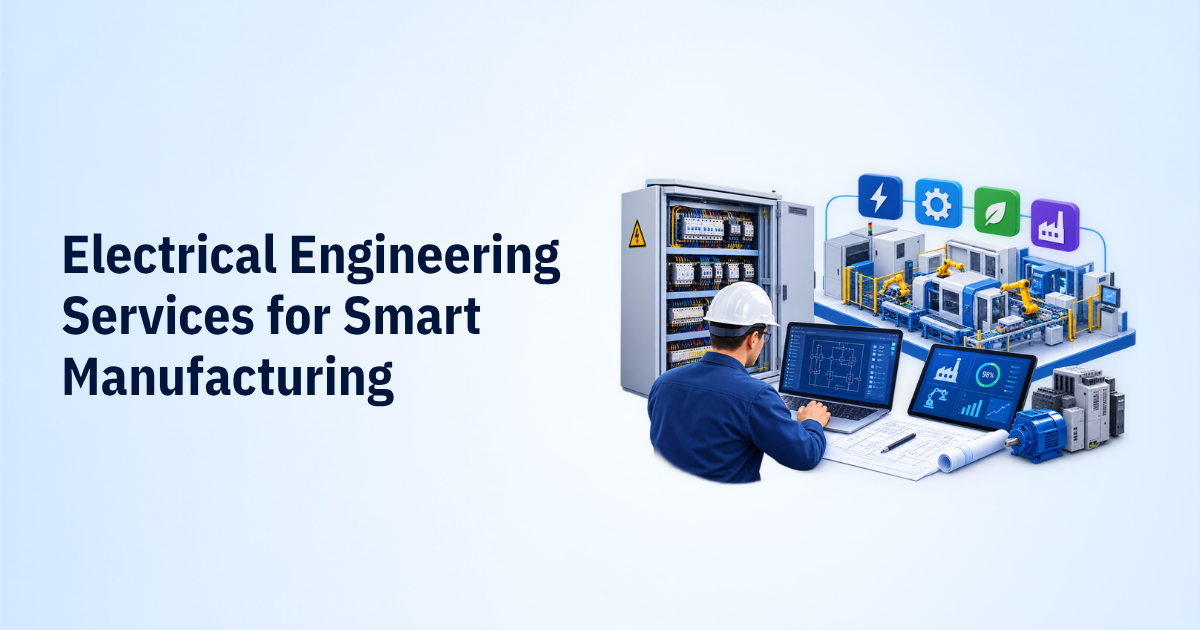
Smart manufacturing depends on more than software dashboards and sensors. To make a factory genuinely smart, manufacturers need electrical engineering services that create a reliable power foundation, connect machines safely, and turn field-level signals into usable production data.
Electrical engineering consulting helps manufacturers plan that foundation. It brings together power distribution, control-system design, automation electrical engineering, instrumentation, and system integration so that equipment, data, and people can work together. This is where manufacturing engineering services become especially useful: they connect electrical design decisions to real production goals, such as uptime, throughput, safety, and scalability.
Electrical engineering services in smart manufacturing cover the design, integration, and support of the electrical and control systems that run a factory. They include power distribution, control panels, PLC and SCADA systems, instrumentation, wiring, machine connectivity, testing, and documentation.
In a traditional plant, these systems mainly keep machines running. In a smart factory, they also make machines observable. Sensors, controllers, drives, and gateways collect information about energy use, machine status, cycle times, faults, and safety conditions. That information can then support better scheduling, maintenance, quality control, and production planning.
A practical smart manufacturing program usually needs:
The goal is not simply to add technology. It is to make the electrical infrastructure capable of supporting smarter decisions on the shop floor.
Electrical engineering consulting is important because smart manufacturing fails most often at the connection points between machines, controls, power systems, and software. A consultant helps manufacturers identify those gaps before they become costly integration problems.
Many plants already have a mix of new machines, older PLCs, local control panels, and equipment from different vendors. Adding a smart manufacturing platform without reviewing the electrical and control architecture can create data silos, unreliable signals, safety risks, or unnecessary hardware replacement.
Electrical engineering consulting brings structure to that situation. It reviews existing loads, control logic, communication paths, safety requirements, and expansion plans. Then it recommends a practical route: what can be connected now, what should be upgraded later, and what should remain unchanged.
This matters because smart manufacturing is growing quickly. IoT Analytics estimates that the global smart manufacturing market reached $175 billion in 2025 and is projected to reach $274 billion by 2030, growing at a 9.3% CAGR. Growth alone does not guarantee results, though; the factories that benefit most are the ones who’s electrical and control foundations can support the technology.
The most useful electrical engineering services for smart manufacturing are those that improve reliability, visibility, safety, and integration. They should support both current production needs and future digital growth.
Industrial electrical design services begin with a clear view of how power moves through the plant. Engineers assess equipment loads, voltage levels, panel capacity, grounding, protection, and future expansion needs.
Good power design reduces nuisance trips, voltage issues, and unplanned downtime. It also creates a stable environment where sensitive automation equipment, drives, sensors, and controllers need to operate reliably.
Automation electrical engineering focuses on how machines are controlled and coordinated. This includes PLC programming, motor control, safety circuits, HMI design, SCADA integration, and control-panel engineering.
For smart manufacturing, the important question is not only “Can the machine run?” but also “Can the machine share useful information?” A well-designed control system captures relevant signals without overwhelming operators or creating unnecessary data complexity.
Automation also changes how teams manage production. When machines, controls, and monitoring systems are designed to work together, manufacturers can respond faster to faults, plan maintenance more effectively, and improve line performance. This operational impact is explored further in our article on how automation shapes modern manufacturing.
Smart manufacturing solutions need a path from the machine to the systems that use the data. Electrical engineers design those pathways through industrial networks, edge devices, gateways, and secure communication links.
This is where legacy equipment often becomes a challenge. Older machines may not have modern communication ports or standardized data formats. Rather than replacing everything, a practical approach uses selective upgrades, protocol conversion, edge gateways, and phased integration.
Sensors turn physical activity into measurable information. Electrical engineers select and integrate instruments for temperature, pressure, vibration, position, energy use, flow, and machine status.
The value comes from choosing sensors that answer a specific operational question. For example, a vibration sensor on a critical motor can support condition-based maintenance, while energy metering can reveal which production areas consume the most power.
A smart electrical system is only useful if it works safely and consistently. Testing verifies wiring, control logic, safety interlocks, network communication, and system behavior under real operating conditions.
Documentation is equally important. Accurate drawings, panel schedules, I/O lists, network diagrams, and as-built records help maintenance teams troubleshoot faster and make future upgrades less risky.
Smart manufacturing software and electrical systems work together through a simple flow: electrical devices collect signals, control systems manage equipment, and software turns that information into insight.
A smart manufacturing platform may visualize production performance, trigger maintenance alerts, compare line efficiency, or support scheduling decisions. But it cannot do this reliably if the underlying electrical and control systems are inconsistent.
For example:
The software is a visible layer, but electrical engineering makes the data trustworthy. If signals are poorly wired, incorrectly mapped, or affected by power disturbances, the platform may show incomplete or misleading information.
This becomes even more important when manufacturers introduce AI-based decision support. AI can identify patterns in downtime, quality variation, energy consumption, and machine behavior, but only when it receives clean, reliable production data. Our article on AI’s contribution to smart manufacturing explains why data quality and system integration matter so much for AI-driven manufacturing.
This is why electrical engineering consulting should happen before or alongside software selection; not after implementation problems appear.
Yes. Smart manufacturing can work with legacy equipment when manufacturers take a phased, engineering-led approach instead of replacing every machine at once.
Many older machines still perform their core function well. The issue is usually limited visibility, outdated communication methods, or undocumented control logic. Electrical engineers can often add value by installing sensors, upgrading panels selectively, adding gateways, or mapping existing PLC signals to a modern data layer.
A sensible legacy-integration approach includes:
This approach protects existing capital investment while still moving the plant toward smarter operations.
A good electrical engineering consultant should deliver more than drawings. The deliverable should be a safe, maintainable, and scalable electrical and control foundation for smart manufacturing.
Typical deliverables include:
The most valuable consultants also understand manufacturing operations. They ask about bottlenecks, downtime causes, quality issues, maintenance constraints, and future production plans. That context helps them design electrical systems that support business outcomes rather than simply adding technology.
Manufacturers manage cybersecurity in smart manufacturing by treating electrical and control systems as part of operational technology security, not just IT. Connected PLCs, drives, HMIs, sensors, and gateways all need protection.
The ISA/IEC 62443 series provide requirements and processes for securing industrial automation and control systems across people, processes, and technology. For manufacturers, this means considering network segmentation, access control, secure remote access, device configuration, monitoring, and recovery planning.
Electrical engineering consulting should include these questions early:
Security should be built into the electrical and control design, not added after the system is connected.
Manufacturers should start with a focused electrical and control-system assessment rather than a plant-wide technology rollout. The assessment reveals where connected automation can create the most value with the least disruption.
A practical starting sequence is:
This keeps the program manageable and gives teams evidence before they commit to larger investments.

A successful smart factory electrical design is safe, reliable, documented, and flexible enough to grow with production needs. It connects machines without disrupting operations and creates data that operations teams can actually use.
The best designs balance three priorities:
Manufacturers should avoid treating smart manufacturing as a single software purchase. The stronger approach is to build an electrical and automation foundation that can support multiple smart manufacturing solutions over time.
Katalyst Engineering supports manufacturers with electrical design, control-system integration, automation engineering, and production-focused engineering support. The focus is on making electrical infrastructure practical for real factory conditions.
Whether the requirement involves a new line, a plant expansion, or connecting existing equipment to a smarter data layer, the starting point is the same: understand the production problem, assess the electrical and control environment, and design a solution that can grow with the operation.

1. What electrical engineering services are needed for smart manufacturing?
Smart manufacturing typically needs power distribution design, control-panel engineering, PLC and SCADA integration, instrumentation, machine connectivity, testing, and documentation. These services create an electrical foundation that allows equipment and software to work together reliably.
2. Can older machines be part of a smart factory?
Yes. Older machines can often be connected using sensors, edge gateways, protocol converters, or selective control upgrades. A phased approach lets manufacturers improve visibility without replacing equipment that still performs well.
3. What is the role of PLCs in smart manufacturing?
PLCs control machines and safety functions while collecting operational signals such as status, faults, cycle data, and process values. In smart manufacturing, properly designed PLC integration helps send useful information to higher-level systems.
4. Is smart manufacturing software enough to make a factory smart?
No. Software provides visibility and analytics, but it depends on reliable electrical systems, sensors, controllers, and communication paths. Without a strong electrical foundation, the software may receive incomplete or inconsistent data.
5. How does electrical engineering consulting reduce project risk?
Consulting reduces risk by identifying power constraints, control gaps, safety needs, integration issues, and documentation problems before implementation. This helps manufacturers prioritize upgrades and avoid unexpected costs during deployment.
6. What is OT cybersecurity in manufacturing?
OT cybersecurity protects industrial operational technology such as PLCs, SCADA systems, HMIs, drives, sensors, and industrial networks. Standards such as ISA/IEC 62443 provide guidance for securing these systems throughout their lifecycle.
7. When should a manufacturer involve an electrical engineering consultant?
A manufacturer should involve an electrical engineering consultant during early planning, before major automation upgrades, plant expansions, or smart manufacturing software implementation. Early involvement helps align electrical design with production and business goals.
8. What should manufacturers look for in an electrical engineering partner?
Look for a partner with experience in industrial electrical design, automation integration, legacy systems, documentation, testing, and manufacturing operations. The partner should also be able to explain trade-offs in clear, practical terms.

Senior Vice President, Katalyst Engineering
Bhavik Shah is the Vice President of Global Engineering and Manufacturing at Katalyst Engineering, with over 22 years of experience in the engineering industry. He specializes in product development, R&D, and engineering delivery operations, driving innovative, design-led solutions across automotive, industrial, and off-highway sectors. Bhavik plays a key role in strengthening engineering strategies, building global partnerships, and delivering high-performance outcomes for clients.